

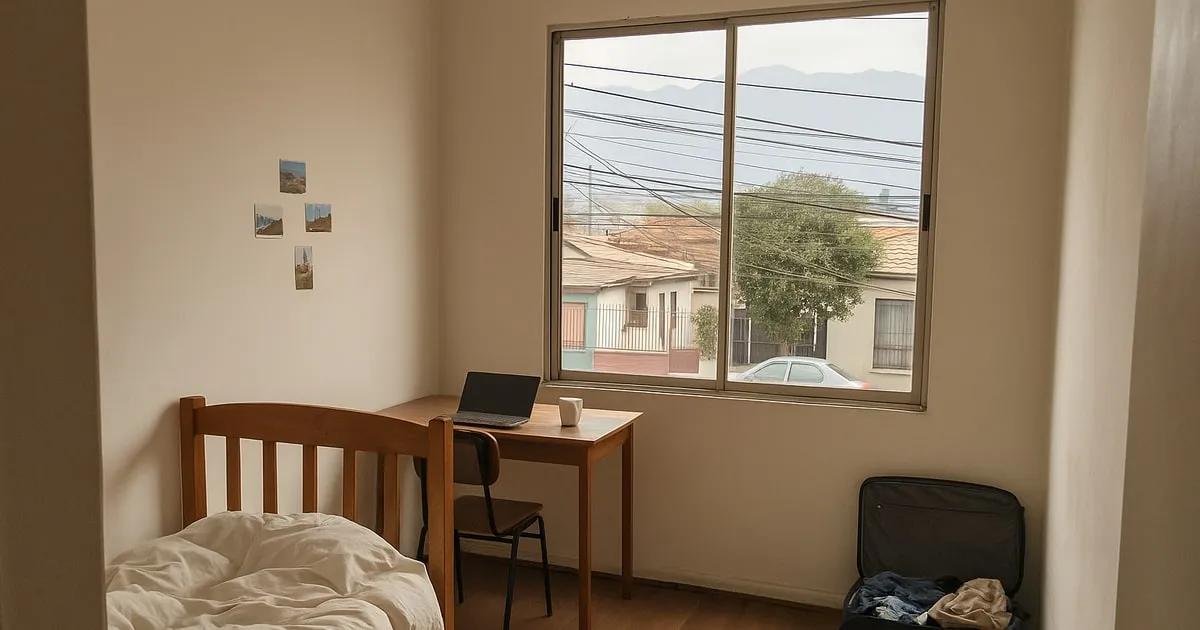
In Santiago, exchange students most often live in a furnished room in a shared casa or in a departamento flatshare, for €350 to €500 a month (about £297 to £424), or in a furnished studio for €420 to €650. Everything is booked online from abroad, without a Chilean bank account, with a single month's rent as a deposit, and your contract is signed before you leave. This guide walks through the market: the housing options, the prices, the areas and the metro that shape the city, then the right time to look. For the full budget item by item, see the article on the cost of living in Santiago.
1. Which housing types exist in Santiago
In Santiago, exchange students choose between five main options, and a room in a shared casa is as popular as a flatshare in an apartment. The city is huge: houses with patios in residential areas, apartment blocks in the denser districts, which gives a wide range for one semester.
- Room in a shared casa: a furnished room in a house, with a shared kitchen and living room, often a patio or terrace. This is the option of weekend asados and of flatmates who become your crowd for the semester.
- Room in a shared departamento: the same idea in an apartment, in a block.
- Furnished studio: your own space, for those who prefer independence to group living.
- Shared apartment for two or three: you rent together and split the rent, a middle ground between privacy and shared life.
- Room with a host: you live with a Chilean family, at the rhythm of their home.
Everything is rented furnished on the student side, by the semester (5 months) or by the year (10 months). You arrive with your suitcase, you have nothing to buy to settle in and nothing to sell when you leave.
The casa has a charm of its own in Santiago: the patio where an asado gets improvised on a Saturday, the nights out organised as a group, and Wednesday evening at Miércoles Po', the exchange students' party night and their favourite, where Flatmaters students get free entry all semester. If living with people you do not know yet makes you hesitate, read why a flatshare with strangers often clicks.
No option is better in absolute terms: it depends on whether you want group life or independence. A studio gives you quiet, a casa gives you a house full of people from the day you arrive, in a city where all the international students land at about the same time.
2. What student housing costs in Santiago
For a good-quality room in a casa or flatshare in Santiago, expect €350 to €500 a month. Rent remains the biggest item in your budget, ahead of food and transport.
| Type of housing | Monthly rent | Approximate equivalent |
|---|---|---|
| Room in a casa or flatshare | €350 to €500 | about £297 to £424 / US$392 to US$560 / 382,000 to 546,000 CLP |
| Furnished studio | €420 to €650 | about £356 to £551 / US$470 to US$728 / 458,000 to 709,000 CLP |
| Shared apartment (2 to 3 bedrooms) | €330 to €550 per person | about £280 to £466 / US$370 to US$616 / 360,000 to 600,000 CLP |
| Room with a host | €420 to €600 | about £356 to £508 / US$470 to US$672 / 458,000 to 655,000 CLP |
The pound, dollar and peso amounts are approximate, converted at the rate used for this guide (€1 is about 1,091 CLP, £0.85 and US$1.12). On top of these rents come the gastos comunes when the home is in a block, and, in some homes, water, electricity and gas bills (all explained below). In total, a standard student budget in Santiago is around €1,055 a month, housing included, which is 10 to 15% less than a typical European student city. The item-by-item detail is in the monthly budget of a student in Santiago, to be cross-checked with the public data from Numbeo for Santiago.
On listing portals, you will see rooms in Santiago advertised well below €350, sometimes half that. In most cases these are run-down homes, or ones whose photos no longer match reality. Many students end up moving out during the semester, disappointed, which costs more than paying the fair price from the start.
3. Where to live in Santiago: areas and metro lines
In Santiago there is no single student neighbourhood: universities are spread across the whole city, and it is the metro that decides your daily life, much more than the name of the area.
The network has 7 lines (1, 2, 3, 4, 4A, 5 and 6). A metro trip costs 895 CLP at peak hours (about €0.82 or £0.70), 815 CLP off-peak (€0.75 or £0.63) and 735 CLP early in the morning and late at night (€0.67 or £0.57); the Red bus costs 795 CLP (€0.73 or £0.62) at any hour. You pay with the Bip! card, or directly with your contactless bank card in all metro stations. Timetables, connections and the other modes are covered in our guide to getting around Santiago as a student.
When they look for housing, students first consider three things: proximity to the metro, proximity to university centres and how safe the area feels. Santiago Centro, Ñuñoa and Macul often come up in their searches for these reasons. No area is better than another: each has its own atmosphere, and it is your everyday journey that makes the difference.
The centre: Santiago Centro, Lastarria and Bellavista
The heart of the city is a reference point for several campuses: Universidad de Chile on the Alameda, UDP in the university district, the PUC Casa Central, the UNAB República campus. You will find La Vega Central for fruit and vegetables, Cerro Santa Lucía, and the streets of Lastarria and Bellavista, where a good share of student nights out happen, at the foot of Cerro San Cristóbal.
Providencia, Ñuñoa and the east of the city
To the east, Providencia and Ñuñoa, then Las Condes and Vitacura, form the other large group of areas where students live. It is also the direction of UAI, based in Peñalolén, and of the Andes, which close the horizon: Farellones and El Colorado are about 36 km away and Valle Nevado about 46 km, enough to go skiing at the weekend during the season, from mid-June to early October or so.
The west and the south
USACH is in Estación Central; further south is the PUC San Joaquín campus. These reference points say one thing above all: with campuses this spread out, the right room depends on your journey, not on a fashionable address.
Before choosing your room, look at the metro line rather than the neighbourhood. It is the line that will decide your travel time for five months.
Matthieu, co-founder of FlatmatersThe TNE, the Chilean student transport card, is not accessible in practice to exchange students. So budget for the standard metro and bus fares: they remain modest over a month.
Browse the casas, flatshares and studios available for your semester, with clear prices and secure booking.
See housing in Santiago4. Booking from abroad, without a Chilean account
You can book your room in Santiago from home, before boarding the plane and without a Chilean bank account: booking is done online, from the listing.
Paying officially reserves the room as soon as it is validated. When you book, you pay the deposit, the equivalent of one month's rent, and nothing else. The landlord has 24 hours to accept: if they decline or do not reply, you are fully refunded. If they accept, they sign the rental contract electronically and your room is confirmed.
Payment is made by international bank transfer from a European account, and the price is fixed at the time of booking: it does not change, whatever happens to the peso before you arrive. Every step is in our article on booking your room in Santiago from abroad. How the platform works is summarised in how it works, and the team behind it is introduced on the about page.
5. Garantía, gastos comunes and the contract
Three words come up constantly in listings in Santiago, plus a budget item of its own: understanding them avoids misunderstandings when you book.
The garantía
This is the deposit, and it is exactly the sum you pay to book: nothing is added on top. At Flatmaters it equals a single month's rent, held in a separate account for the whole rental, then returned at the end of your stay after the condition of the home is checked.
The gastos comunes
These are the building's service charges: upkeep of shared areas, the concierge, the lift. They mostly concern homes in apartment blocks. Their amount depends entirely on the building and the services it offers, and they add to the rent in your housing budget.
Utility bills
In some homes, water, electricity and gas are not included in the rent and are paid separately, according to what the flatshare actually uses. It is a budget line separate from the gastos comunes.
The contract
The rental contract is signed electronically by the landlord as soon as your booking is confirmed, so before you leave: you travel with your contract already signed. When you arrive, make a habit of quickly reporting any difference between the listing and the home.
6. The right moment to start looking
To have a choice in Santiago, the earlier the better: the sooner you book, the wider the range of available rooms.
The Chilean academic year is inverted compared with the northern hemisphere, with two intakes: early March for the first semester, early August for the second. You aim for one of those two windows, like every international student of your semester.
Booking early means access to casas with patios, to flatshares close to the metro line that suits you and to studios, instead of choosing from what is left. It also means arriving straight at your home, dropping your suitcase and heading out that same evening to discover Lastarria or Bellavista, rather than spending your first days searching. To picture your future daily life, take a look at student life in Santiago.
7. Frequently asked questions
Should I book my housing in Santiago before arriving?
Nothing obliges you to, but booking from your home country guarantees you a room on the day you arrive, with no week in a hostel and no last-minute search. And the earlier you start, the more choice you have between casas, flatshares and studios.
How much does a student room cost in Santiago?
Expect €350 to €500 a month for a room in a casa or flatshare, €420 to €650 for a furnished studio, €330 to €550 per person in a shared apartment and €420 to €600 with a host. On top come the gastos comunes in a block and, in some homes, utility bills. A standard budget is around €1,055 a month, housing included.
Can I rent in Santiago without a Chilean bank account?
Yes. With Flatmaters, you book online and pay by international bank transfer from a European account. Paying officially reserves the room, and the landlord has 24 hours to accept, otherwise you are fully refunded.
Is student housing in Santiago furnished?
Yes, everything is rented furnished on the student side. The rental is by the semester (5 months) or by the year (10 months), and you have nothing to buy to settle in.
Which area of Santiago should I live in?
No area is better than another: universities are spread across the whole city, from the centre to the east via Estación Central and San Joaquín. Students mainly look at proximity to the metro and to university centres and how safe the area feels, then at the daily journey to their classes.
Why are some rooms so much cheaper?
Below about €350 a month, these are most often run-down homes or ones whose photos no longer match reality. Many students who chose these rooms move out during the semester, disappointed.
What are the garantía and the gastos comunes?
The garantía is the deposit: at Flatmaters, a single month's rent, paid when you book and nothing else, held in a separate account and returned at the end of your stay. The gastos comunes are a building's service charges (upkeep of shared areas, concierge, lift). Water, electricity and gas are paid separately in some homes.