

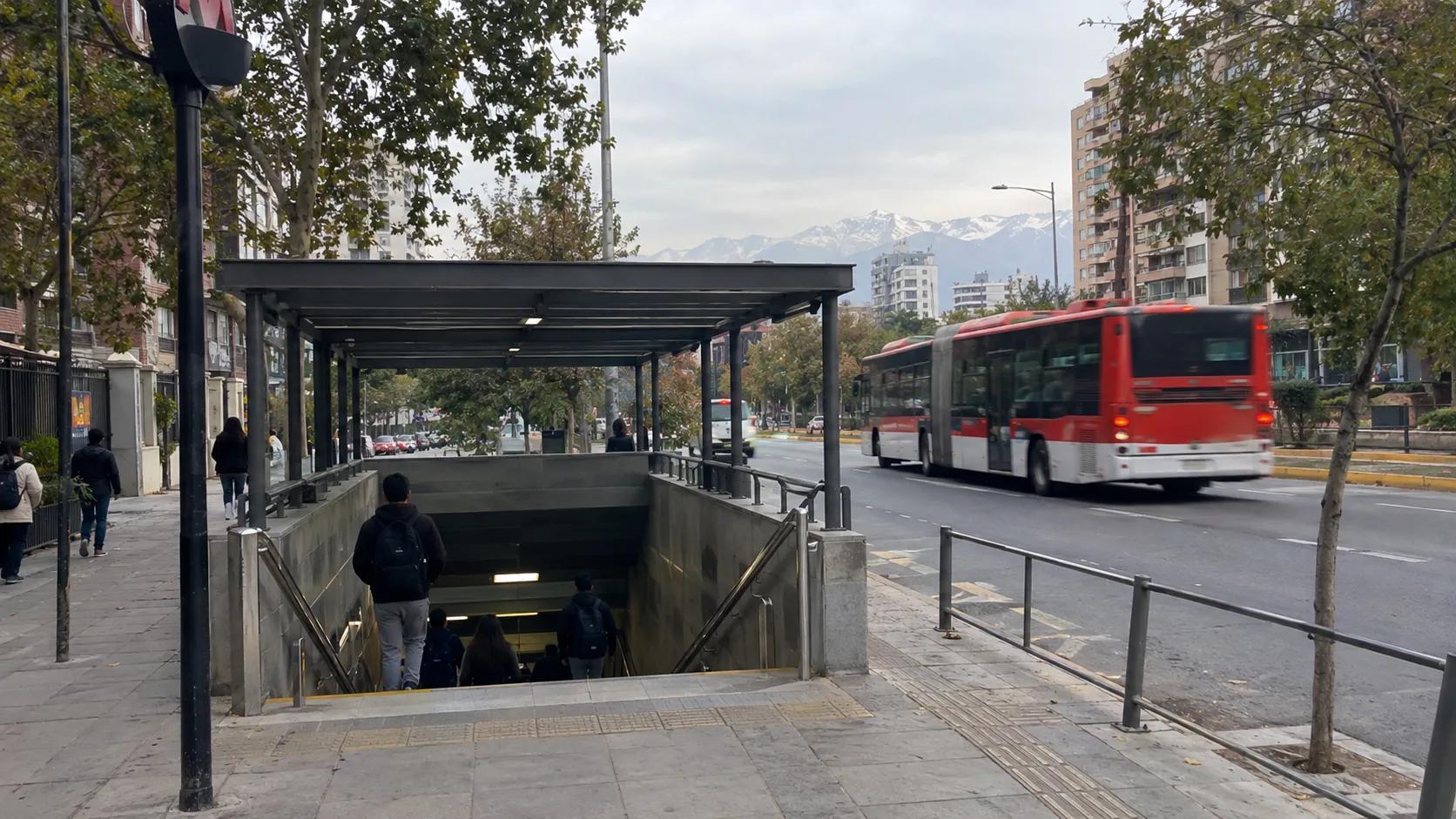
In Santiago you mostly get around by metro and by bus, the micros, all part of the Red network. A metro journey costs between 735 and 895 pesos depending on the time (€0.68 to €0.82), and a bus journey 795 pesos (€0.73). The metro now takes contactless bank cards, but buses still require the Bip! card, which costs 1,550 pesos (€1.43). With it, bus and metro transfers are integrated for two hours. To get a feel for daily life in the city, see also student life in Santiago.
1. The network at a glance: metro, buses and train
The Red network brings the metro, buses and the Tren Nos together under one payment and transfer system. It is what you will use every day.
- The metro: seven lines (1, 2, 3, 4, 4A, 5 and 6) covering the centre and much of the city. On weekdays it runs from roughly 6am to 11pm. Line 7, under construction, will not open before the end of 2028.
- The buses, or micros: hundreds of routes that go where the metro does not, and take over at night.
- The Tren Nos: a commuter train heading south, part of the same system.
For journey planning, the Red app, Moovit and Google Maps show timetables and stops in real time.
2. What a journey costs
The metro fare depends on the time you tap in; the bus costs the same all day. These are the current fares.
| Mode and time (weekdays) | Fare |
|---|---|
| Metro, peak (7:00-8:59 and 18:00-19:59) | 895 CLP (€0.82) |
| Metro, off-peak (9:00-17:59 and 20:00-20:44) | 815 CLP (€0.75) |
| Metro, low (6:00-6:59 and 20:45-23:00) | 735 CLP (€0.68) |
| Red bus, all day | 795 CLP (€0.73) |
Fares are reviewed regularly by the authorities. At these prices, a return trip every weekday comes to about €35 a month, before evenings out and weekends. The rest of your budget is covered in our article on the cost of living in Santiago.
3. Paying: Bip! card, bank card or QR
Three ways of paying coexist, and the simplest option for a student is still to get a Bip! card in your first few days.
The Bip! card
This is Santiago's rechargeable travel card. It costs 1,550 pesos and is sold at metro ticket offices and Bip! centres. You top it up at ticket offices, station machines and many supermarkets. It is currently the only way to pay on buses.
Contactless bank cards
Since February, the metro and the Tren Nos accept contactless Visa and Mastercard cards, as well as wallets such as Apple Pay or Google Wallet. Foreign cards work too, but check with your bank that yours is enabled for contactless and look at the fees on payments in pesos. Red buses do not accept them yet: the switch to bank card payment is announced for the end of the year.
QR
A prepaid Bip!QR account lets you tap in with your phone. It is a handy fallback.
If you pay by bank card, always use the same card or device to enter and to transfer: going in with your phone and transferring with the physical card counts as two different passengers, so two fares.
4. Transfers
With the Bip! card, one journey can combine up to three vehicles within two hours for a single base fare. You pay for the first leg, then transfers are free or only cost the fare difference, for example when you switch from a bus to the metro at peak time.
A few rules: you cannot take the same bus route twice in one journey, and only one metro entry counts. For a home-to-campus trip with a bus and then the metro, you pay once.
Browse the rooms available for your semester and check the nearest station before you book.
See housing in Santiago5. The TNE and student fares
The TNE, Chile's national student card, gives access to reduced transport fares. But it is reserved for regular students at Chilean institutions and, in practice, it is not available to exchange students: some universities warn their international students that JUNAEB, the body that issues it, does not grant them a provisional pass.
For your budget, plan on the full fare. If your university tells you otherwise for your specific case, all the better, but do not build your budget on it.
Before choosing your room, look at the metro line rather than the neighbourhood. That is what will decide your commute for five months.
Matthieu, cofounder of Flatmaters6. Bikes, scooters and ride-hailing
Bike sharing
Bike Santiago has around 3,000 bikes across 14 districts, including Santiago Centro, Providencia and Vitacura. You need to be over 18 and have a bank card to sign up in the app. Cycle lanes have spread across the centre and towards the east, and riding along the Parque Forestal or the Mapocho river is a pleasant way to cross the city.
Ride-hailing
Uber, DiDi and Cabify are widely used, especially to get home after 11pm when the metro has closed. Split between a few people, a shared ride is usually reasonable.
To book your future room from home, everything is explained on how it works, and you can find out who we are on the about page.
7. Frequently asked questions
How much is a metro ticket in Santiago?
Between 735 and 895 pesos (€0.68 to €0.82) depending on the time: 895 at peak, 815 off-peak and 735 early in the morning or late in the evening. The bus costs 795 pesos (€0.73) all day.
Can I pay for the Santiago metro with a foreign bank card?
Yes, with a contactless Visa or Mastercard, or a wallet such as Apple Pay or Google Wallet. Check with your bank that contactless is enabled and look at the fees on payments in pesos. Buses still require the Bip! card.
Where can I buy a Bip! card?
At metro station ticket offices and Bip! centres. It costs 1,550 pesos (€1.43) and can be topped up at ticket offices, station machines and many supermarkets.
Do exchange students get a student fare?
In practice, no. The reduced fare goes through the TNE, reserved for regular students at Chilean institutions, and JUNAEB does not issue a provisional pass to foreign exchange students. Plan on the full fare in your budget.
How do I get home once the metro has closed?
Some bus routes keep running, and Uber, DiDi and Cabify are widely used for late journeys. Split between a few people, a shared ride usually works out cheap.