
Santiago is a city of 7 million people set between the Pacific Ocean to the west and the Andes to the east. For an exchange student, it is a rare playground: the political and economic capital of a stable country, a nightlife that runs until dawn, and the chance to ski or hike 90 minutes from your front door.
This guide covers everything you live when you study here, from metro commutes to weekend carretes. Up to date for spring 2026.
Santiago, first contact
The first thing you notice when you land: the mountains. When the sky is clear, the Andes loom over the skyline from pretty much every corner of the city. It is beautiful, and it helps you find your bearings: east = Andes, west = Pacific, north-south = the central plain.
Climate and seasons
Santiago runs on the southern hemisphere clock. The seasons are inverted compared with the UK and Western Europe:
- Summer (December to March): hot and dry, 25 to 32 °C in the daytime. Nights are often cool (15-18 °C). This is the university holiday season.
- Autumn (April-May): mild and pleasant, with leaves turning colour in the parks.
- Winter (June to August): 5 to 15 °C, not freezing outside, but indoors it can feel chilly: home insulation follows local standards (thinner than in northern Europe). Days are shorter.
- Spring (September-November): mild and full of blossom, one of the loveliest seasons for outdoor life.
Altitude and the city air
Santiago sits at 570 metres of altitude, ringed by mountains. That geography is part of its charm: clear-sky days give you Andes views from almost everywhere. In spring, summer and autumn, the air is broadly clear. In winter, certain days can be a little heavier and the city council issues advisories. Nothing that affects student life day to day, especially as Santiago stays active year-round around sport, the mountains and the cultural scene.
The city zones
Santiago is divided into around thirty comunas, districts each with their own town hall and atmosphere. The most familiar ones when you arrive:
- Santiago Centro: the historic core, the Plaza de Armas, the presidential palace at La Moneda. Lively, working class, close to everything.
- Providencia: right north-east of the centre. Dense, leafy, well-loved for its café and restaurant scene.
- Las Condes: further east, the business district with the glass towers of "Sanhattan". Modern, commercial, a little pricier.
- Ñuñoa: also east, more residential and bohemian. Very popular with Chilean students for its bars and laid-back vibe.
- Vitacura: further east still, upmarket residential, close to green spaces and large supermarkets.
- Bellavista (a neighbourhood, not a comuna): between the centre and Providencia, at the foot of Cerro San Cristóbal. This is where a good chunk of the bohemian nightlife concentrates. Be careful though, the area can be dangerous at night: better to stay in a group and take a taxi or Uber home.
Each zone has its own character. You will end up finding yours naturally, depending on your classes, your friends, and the kind of pace you want.
Getting around the city
The good news: Santiago has the best metro in Latin America. Clean, reliable, relatively quick. The bad news: it gets packed at rush hour (8-9 am, 6-7 pm).
The Santiago metro
7 lines, more than 130 stations. It covers nearly every zone useful to a student. Lines 1 (east-west, red) and 5 (purple) are the most practical day to day. Frequency: 2 to 5 minutes at peak, 5 to 10 minutes off peak. Service runs from around 6 am to 11 pm.
The Bip! card
Your universal transport card. You top it up at any metro station or in Bip! kiosks. It works on the metro, on Red Movilidad buses, and on some suburban train lines. A trip costs around 900 CLP (roughly EUR 0.90 / £0.75 / $1), all modes combined, with free transfers within a 2-hour window.
Tip
Buy your Bip! card on day one in Santiago. Without it, buses refuse cash payment and you end up walking. Top-ups can be paid in cash or by card at station machines.
Uber, DiDi and taxis
Uber works very well in Santiago (officially licensed since 2024). DiDi is often cheaper. Traditional taxis are black with a yellow roof: they exist, but most students prefer the apps to avoid disputes over fares.
Bikes and scooters
Santiago has built a network of cycle lanes, mostly along the Providencia-Las Condes axis. The bike-share scheme works but is still a work in progress. For short distances in the central districts, a personal bike remains practical.
The Chilean university rhythm
What surprises you most on arrival: Chilean semesters are shifted by 6 months compared with the UK and continental Europe. Summer holidays fall in the middle of the southern summer, from mid-December to early March.
Typical calendar
- First semester: classes start in early March, end in early July.
- Winter break: 2 to 3 weeks in July.
- Second semester: early August to mid-December.
- Summer break: mid-December to early March.
The teaching day
Classes can run from 8.30 am to 8 pm, often with a long lunch break (1 to 3 pm). Timetables are more spread out than in Europe: a typical student has 3 to 5 classes per day, rarely back to back.
Good news for international students: Chilean universities usually adapt their schedules to bunch classes onto a few days, which makes weekend travel easy. Saturday classes exist for some Chilean degree tracks but never for exchange students.
Student life around classes
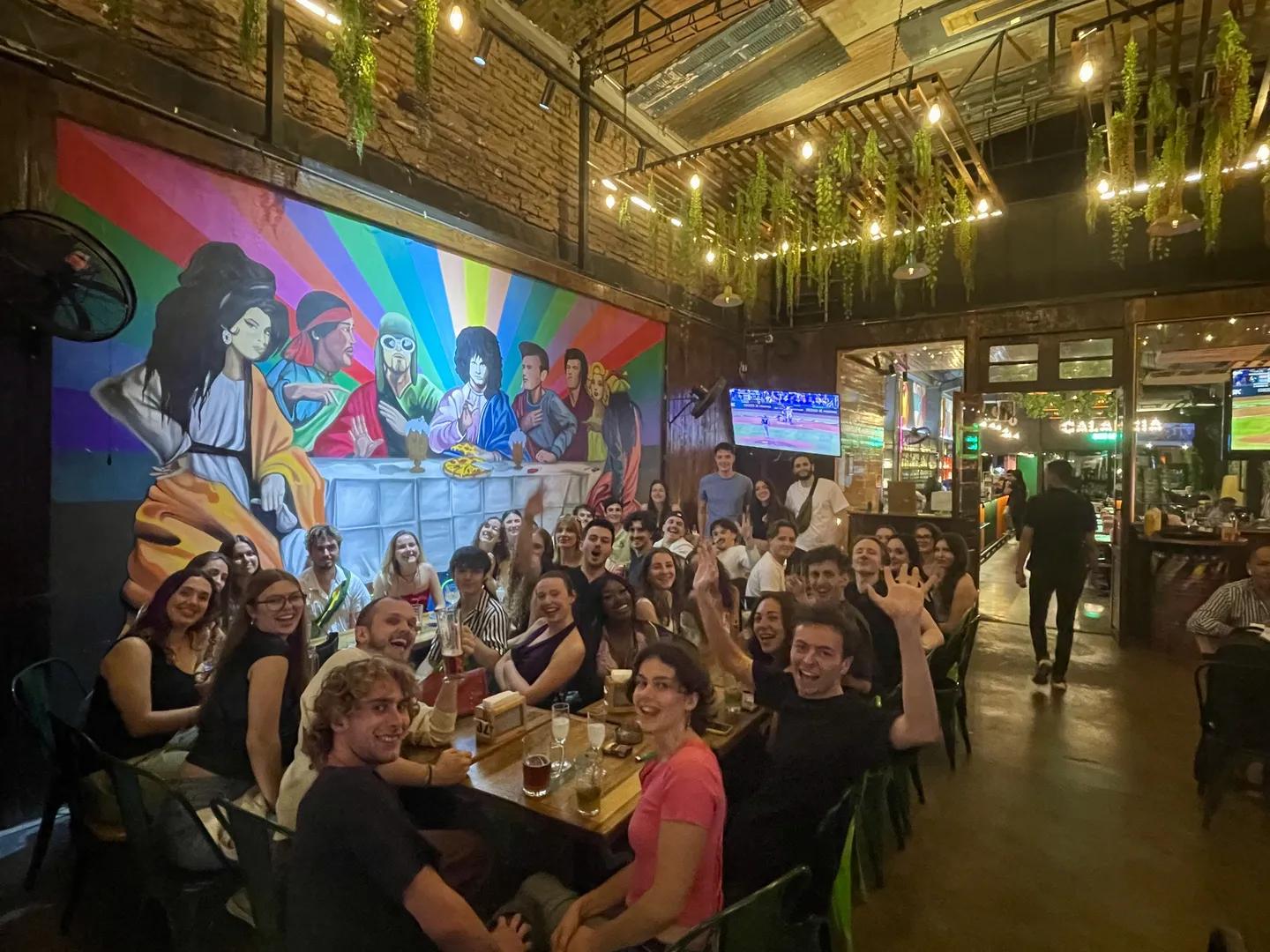
The carrete (the student night out) sits at the heart of campus life. Parties rarely start before 11 pm and often run until 5 am. Student unions regularly organise inter-faculty events: the bienvenida at the start of the semester, end-of-term parties, anniversary celebrations of the university.
Eating and cooking in Chile
Chilean cuisine is generous, hearty, with authentic dishes you learn to appreciate.
Dishes to know
- Empanada de pino: pastry filled with minced beef, onion, hard-boiled egg, olive. The national classic, especially on 18 September.
- Completo: the Chilean hot dog (completos), with tomato, avocado, mayo, mild chilli. Everywhere and dangerously good.
- Pastel de choclo: fresh sweetcorn gratin with beef and chicken, one of the iconic dishes.
- Cazuela: Chilean stew, ideal in winter.
- Sopaipillas: fried pumpkin fritters, sold in the street on rainy days.
- Ceviche: raw marinated fish, more common on the coast but available everywhere.
Mealtimes and habits
The almuerzo (lunch) is the main meal of the day, between 1 and 3 pm. Restaurants offer a menú del día at EUR 5-10 (£4-£8.50 / $5.50-$11) with starter, main, dessert and a drink. For a student on a tight budget, that is the daily go-to.
The once (pronounced "on-seh") is a uniquely Chilean tradition: a hybrid of afternoon tea and a light dinner, taken between 5 and 7 pm, made of bread, avocado, cheese, cold cuts, tea or coffee. Many Chilean families do not really have dinner, or eat very late.
Shopping and markets
For grocery shopping, four big chains dominate: Jumbo (premium), Líder (think a local Tesco or Carrefour), Santa Isabel (often considered the most affordable supermarkets) and Unimarc (a neighbourhood supermarket). For fruit and vegetables, markets are always 30 to 50% cheaper. La Vega Central (between Santiago Centro and Recoleta) is the largest market in the city, spectacular and cheap.
Going out and unwinding
Bars and rooftops
Bellavista, Lastarria and Italia are three zones where nightlife runs in full swing. You will find cocktail bars, microbreweries and rooftops with a view of the cordillera. A drink will set you back EUR 4 to 8 (£3.50-£7 / $4.40-$8.80) depending on the venue. Evenings start late and end late: turning up at a Chilean bar before 11 pm means being the first one in.
Clubs
The Chilean electronic scene is active. The big clubs (Blondie, Club Chocolate, Club Subterráneo) run themed nights. Entry: EUR 8 to 15 (£7-£13 / $8.80-$16.50) typically. Bring photo ID and cash for the cloakroom.
Miércoles Po', the international student night
It is impossible to talk about going out (carrete) in Santiago without mentioning Miércoles Po', the weekly party run specifically for exchange students every Wednesday. It is the favourite night of international students, the one where everyone meets up at the start of the semester and friend groups start to form. Flatmaters students get free entry to Miércoles Po' for the whole semester.
Culture and museums
Santiago has a rich cultural offering. The GAM (Centro Cultural Gabriela Mistral) hosts exhibitions and theatre. The Museum of Fine Arts, the Museum of Memory and Human Rights (free, essential for understanding contemporary Chile) and the Pre-Columbian Museum are all worth a visit. Cinemas usually screen films in original version with subtitles, handy when your Spanish is still finding its feet.
Parks and green spaces
The Cerro San Cristóbal, inside the Parque Metropolitano, is the green lung of the city. You can go up by funicular, on foot or by bike, and enjoy a 360° view over Santiago. The Parque Bicentenario (Vitacura), the Parque Forestal (centre) and the Parque O'Higgins are all popular at the weekend.
Nature and sport: Andes, beaches, parks
This is the geographical jackpot of Chile: you have the sea, the mountains and the desert all within bus distance. The Andes and the Pacific are both 90 minutes away. Few student cities in the world match that.
The Andes
90 minutes by car from Santiago, you can be at the ski resorts of Valle Nevado, Farellones or Portillo. Season: June to September. Plenty of student buses run at the weekend. In summer, the same resorts open hiking and mountain bike trails.
The beaches
The Chilean coast is 90 minutes to 2.5 hours from Santiago depending on the town. Valparaíso, Viña del Mar, Zapallar, Maitencillo, Cachagua, Algarrobo: every student ends up with their favourite. The water is cool (Humboldt current), but the landscapes and the seaside villages are stunning.
Sport in town
Private universities often have their own gyms, free or very cheap for students. Around town, you will find plenty of chain gyms (Smart Fit, Sportlife). Running at the Parque Bicentenario or around Cerro San Cristóbal is a Chilean habit. Mountain biking outings (rodados) in the Andean foothills attract a fair share of young professionals at the weekend.
Annual festivals not to miss
Fiestas Patrias (18-19 September)
The Chilean national holiday. A whole week, the country shuts down: asados everywhere, cueca dancing in the streets, fondas (temporary marquees) in the parks, Chilean flags at every window. If you are around in September, this is the most intense event of your stay.
Festival de Viña del Mar (late February)
The biggest music festival in Latin America. International artists across a full week. Students head down to Viña del Mar in droves for the occasion.
Lollapalooza Chile (March)
Held in Santiago since 2011. The big names of pop, rock and electronic music all come through. 3-day pass: around EUR 200 (£170 / $220). Lock in your tickets in September-October if you are around for the first semester.
New Year's Eve
The Valparaíso-Viña del Mar fireworks are famous (Chilean students travel down for them). In Santiago, the fireworks fired from the Las Condes towers are spectacular.
Adapting to Chilean Spanish
Good news: even starting from beginner level, Chilean Spanish settles in fast on the ground. The accent is quick and packed with slang, but immersion does the rest. Many students arrive in Santiago without speaking a word of Spanish and leave a semester later at a fluent level, thanks to shared housing, the Spanish-for-foreigners courses run by universities, and daily life.
A few words to know on day one
- Po: a filler word with no precise meaning, tagged onto the end of phrases (sí po, no po).
- Cachái? "you get it?" (extremely common)
- Bacán: cool, great
- Fome: dull, annoying
- Weon/weá: the Chilean equivalent of "mate/thing". Used absolutely everywhere, including affectionately.
- Pololo/polola: boyfriend / girlfriend
- Carrete: a night out
- Copete: an alcoholic drink
For the first two weeks, you understand nothing. Then from the first month on, your ear adjusts. By month three, you are using cachái, po and bacán without thinking about it. That is the moment you know you have settled in.
Matthieu, co-founder of FlatmatersTools for picking it up
Language exchange meet-ups in cafés and on campus make it easy to find partners. Many universities run Spanish courses for international students, often free of charge. Watching Chilean series (La Jauría, El Presidente) on Netflix in original version is also very effective for getting used to the accent.
Find your student housing in Santiago
Studios, shared houses, rooms with a host: every property vetted on the ground by our team.
Find my housingFrequently asked questions
Is Santiago a good city for international students?
Yes. Santiago combines a dense university scene, a cost of living below most large Western European cities, an active cultural life and quick access to nature (Andes to the east, beaches 90 minutes away).
The international community is well established, which makes it easier to settle in for a student arriving on their own.
What is the climate like in Santiago, Chile?
Santiago has four distinct seasons, inverted compared with the northern hemisphere. Summer (December-March) is hot and dry (25-32 °C). Autumn is mild (April-May). Winter is cool (June-August, 5-15 °C). Spring is mild and full of blossom (September-November).
It rarely rains except in mid-winter.
How do you cope with Spanish in Chile when you are a beginner?
Chilean Spanish is approachable, even for outright beginners. The accent is quick and full of slang (po, cachái, bacán, fome), but immersion does the work: many students arrive in Santiago without speaking a word of Spanish and progress naturally through their shared housing, the university and daily life.
Universities often offer Spanish courses for international students (free or low-cost), and language exchange meet-ups in cafés and on campus make it easy to find partners.
Is Santiago safe for students?
Santiago is one of the safest cities in Latin America. Pickpocketing can happen in the metro or in tourist areas. Standard urban awareness is enough: do not flash your phone, avoid certain parks at night, prefer Uber over unofficial taxis when leaving a night out.
What are the must-see annual events in Santiago?
The Fiestas Patrias (18-19 September) is the national holiday: asados, cueca, fondas everywhere. The Festival de Viña del Mar (late February) brings together the biggest Latin American names. Lollapalooza Chile (March) is a major student event. The New Year's Eve fireworks fired from the Las Condes towers are spectacular.
How long does it take to settle into life in Santiago?
For most students we host, the first 2-3 weeks are intense (paperwork, adapting to Chilean Spanish, getting to know your area). From the first month on, daily life stabilises.
The third month is usually the moment when you start to feel at home, when you have your favourite café, your Chilean friends and your own routines.