

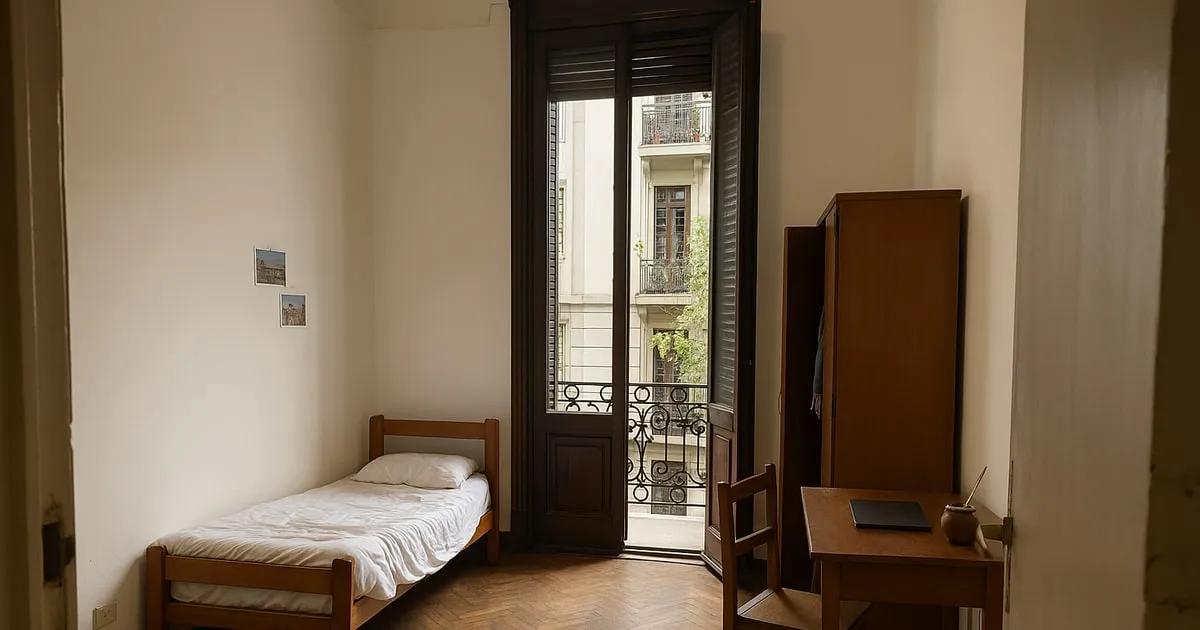
In Buenos Aires, a furnished room in a shared flat costs between €400 and €600 a month (about £340 to £510), and a furnished studio between €650 and €850. Everything is rented furnished, and everything can be booked from abroad, without an Argentine bank account, with a single month's deposit. This guide goes through the types of housing, the barrios where students live, the transport landmarks that matter in daily life and the right time to book. For the full budget, line by line, see our article on the cost of living in Buenos Aires.
1. Which types of housing exist in Buenos Aires
In Buenos Aires, an exchange student chooses between four main options, all furnished: a room in a shared flat, a studio, a shared apartment and a room with a local family. Each one is a different way of living your porteño semester.
- Room in a shared flat: a furnished room in a departamento or a shared house, with a kitchen and living room in common. It is the option of impromptu late dinners, mate shared before class and flatmates you still talk about years later.
- Furnished studio: your own space, at a higher price, for those who prefer independence to group living.
- Shared apartment for two or three: you rent together and split the rent, a middle ground between privacy and shared life.
- Room with a local family: you live with a porteño family and step straight into the rhythm of the city.
Everything is rented furnished on the student side: you arrive with your suitcase and leave with it, with nothing to buy to settle in and nothing to sell when you go. Rentals run by the semester, for five months, or by the year, for ten months, which suits a stay of one or two semesters.
No option is better in absolute terms, it all depends on how you feel about group living. In a city where people eat dinner between 9 and 10 pm and go out after midnight, many students like having flatmates to share that rhythm with, while others prefer to keep a space entirely to themselves.
2. What student housing costs, in brief
For good-quality, well-connected housing in Buenos Aires, expect to pay between €400 and €600 a month for a room in a shared flat. Rent is the biggest item in your budget, ahead of food and transport.
| Type of housing | Monthly rent |
|---|---|
| Room in a shared flat | €400 to €600 |
| Furnished studio | €650 to €850 |
| Shared apartment (2 to 3 bedrooms) | €450 to €700 per person |
| Room with a local family | €500 to €700 |
On the local market, rents offered to foreigners are often quoted in dollars, and the peso moves fast: that is why the ranges here are given in euros. On top of these amounts you may have to pay expensas, the building service charges, as well as utilities. Overall, a student's budget in Buenos Aires comes to around €1,000 to €1,250 a month, housing included. To compare line by line, look at the complete student budget for Buenos Aires, and cross-check with the public data on Numbeo for Buenos Aires.
If you search for a while, you will come across rooms advertised well below these ranges. In most cases they are run-down places, or the photos no longer match reality. Many students end up moving out mid-semester, which costs more, in money and in time, than paying a fair price from the start.
3. Which barrios to live in
International students live in many different barrios of Buenos Aires, each with its own atmosphere: Palermo, San Telmo, Recoleta, Belgrano, Caballito or Almagro, among others. None is a must: what matters is the journey to your classes and the atmosphere you picture yourself living in for five months.
Palermo
Palermo is split into several areas, Palermo Soho, Palermo Hollywood and Palermo Botánico, which porteños name as neighbourhoods in their own right. It is one of the hearts of the city's nightlife, with bars and clubs that fill up after midnight, and one of the places where students meet to eat and go out.
San Telmo
On Sundays, the Feria de San Telmo takes over Plaza Dorrego and the streets around it. The rest of the week, the barrio lives to the rhythm of its bars and evenings out, and remains one of the spots where students eat without spending a fortune.
Recoleta, Belgrano and Núñez
These barrios often serve as landmarks because several universities are located there: UADE is in Recoleta, UTDT in Núñez, and the UBA's Ciudad Universitaria between Belgrano and Núñez. Note, however, that the UBA has faculties spread across the whole city: the exact address of your classes, more than the name of your university, decides your commute.
Caballito, Almagro, Villa Crespo and Chacarita
These barrios make up another part of the student map, each with a neighbourhood life of its own. The Abasto area, on the edge of Almagro, is one of the places where students like to meet for dinner.
Always keep a little efectivo (cash) on you: cash is still essential at the ferias, the milongas and the small neighbourhood shops, even though QR payment with MercadoPago is very widespread.
4. Choosing your room with the Subte in mind
In Buenos Aires, the right way to choose a room is to look at the Subte or colectivo line that connects it to your classes, even before the barrio. The Subte, the porteño metro, and the colectivos, the buses that porteños also call bondis, shape every daily journey.
The SUBE card
The SUBE card pays for the Subte, the colectivos and the trains. You can buy it without any paperwork, then register it in your name with your passport at a SUBE centre. Once registered, you pay the standard fare; without registration, each journey costs noticeably more.
What a journey costs
As a guide, with a registered SUBE, a Subte journey costs around €1 (about 90p) and a short colectivo journey a little over €0.50 (about 45p). Fares are adjusted every month in line with inflation: keep the order of magnitude in mind rather than the amount in pesos. On the Subte, discounts apply to frequent users, from 20% off after 20 journeys in the month up to 40% off after 40 journeys.
Paying by bank card
Contactless Visa or Mastercard and QR payment are accepted at every Subte station and on equipped colectivos. On colectivos, this payment method applies an average fare instead of the distance-based scale. To plan your journeys, the apps Cómo Llego, the official one, and Moovit do the job. The full detail on lines, fares and cycling is in our article on getting around Buenos Aires as a student.
Browse the rooms and studios available for your semester, with clear prices and secure booking.
See housing in Buenos Aires5. Booking your room from abroad
Yes, you can book your housing in Buenos Aires before you leave, without an Argentine bank account and without being there. Everything is done online, from the listing: photos, description, price and rental dates.
In practice, paying officially reserves the room. When you confirm a booking, you pay the deposit, the equivalent of one month's rent, and nothing else. The owner has 24 hours to accept. If they decline or do not reply, you are fully refunded. If they accept, your room is confirmed and they sign the rental contract electronically: you leave with your contract already signed.
Payment is made by international bank transfer from a European account, and the price is fixed at the time of booking: it does not change afterwards, whatever happens to the peso before you arrive. In a city where even transport fares are adjusted every month, that is real peace of mind. The full process is explained in how it works, and if you want to know who is behind the platform, see the about page.
6. Depósito, expensas and the contract
A few words come up again and again in Buenos Aires listings: alquiler, which means the rental and the rent, depósito and expensas. Understanding them saves you from misunderstandings when you book.
The depósito
This is the deposit, and it is exactly the sum you pay to book: nothing is added on top. With Flatmaters, it is a single month's rent, held in a separate account for the whole rental, then returned at the end of your stay after the condition of the property has been checked.
The expensas
These are the service charges of a building, the porteño equivalent of the Chilean gastos comunes: upkeep of the shared areas, the concierge, the lift. Their amount depends entirely on the building and the services it offers, and they often come on top of the rent in your housing budget.
Utilities
In some properties, water, electricity and gas are not included in the rent and are paid separately, according to what the flat actually uses. It is a budget line to plan for, just like the rent.
The contract
With Flatmaters, the rental contract is signed electronically by the owner as soon as your booking is confirmed, well before you leave. You land at Ezeiza with your housing and your contract already sorted, and all that is left is to head to your room.
7. When to start your search
The earlier the better, to have a wider choice: the sooner you book, the more access you have to well-placed shared flats and studios on your Subte or colectivo line, instead of settling for what is left.
Exchange students arrive in large numbers at the start of each semester, and the best-located rooms go first. Choosing early also means being able to weigh up calmly a shared flat, a studio or a room with a local family, and a semester rental against a full-year one.
Booking ahead also means arriving straight at your own place, without a week in a hostel or a last-minute search, and spending your first days discovering the city rather than looking for a roof. To picture your future daily life, have a look at student life in Buenos Aires.
8. Frequently asked questions
Should I book my housing in Buenos Aires before I arrive?
It is strongly advised. Exchange students arrive in large numbers at the start of each semester and the well-located rooms go first. Booking from your home country secures you a place on the day you arrive, with no week in a hostel and no last-minute search.
How much does student housing cost in Buenos Aires?
Expect €400 to €600 a month for a room in a shared flat, €650 to €850 for a furnished studio, €450 to €700 per person in a shared apartment and €500 to €700 with a local family. Expensas and utilities may come on top. Overall, a student's budget is around €1,000 to €1,250 a month, housing included.
Can I rent from abroad without an Argentine bank account?
Yes. With Flatmaters, you book online and pay by international bank transfer from a European account, with no Argentine account and no need to be there. Paying officially reserves the room, and the owner has 24 hours to accept, otherwise you are fully refunded.
What are the depósito and the expensas?
The depósito is the deposit: with Flatmaters, a single month's rent, which is exactly the sum paid to book, held in a separate account and returned at the end of the stay after the condition of the property has been checked. The expensas are a building's service charges (upkeep of shared areas, concierge, lift). Separately, water, electricity and gas are not included in the rent of every property.
Is student housing furnished in Buenos Aires?
Yes, everything is rented furnished on the student side. You can rent by the semester, for five months, or by the year, for ten months, and you have nothing to buy to settle in.
Which barrios do students live in in Buenos Aires?
International students live in many barrios, including Palermo, San Telmo, Recoleta, Belgrano, Caballito or Almagro. None is a must: the criterion that matters most day to day is the Subte or colectivo journey to your classes.
Do I need a SUBE card to get around from my accommodation?
The SUBE pays for the Subte, the colectivos and the trains. Registered in your name with your passport, it gives you the standard fare; without registration, each journey costs noticeably more. Contactless bank cards and QR are also accepted at every Subte station and on equipped colectivos.