

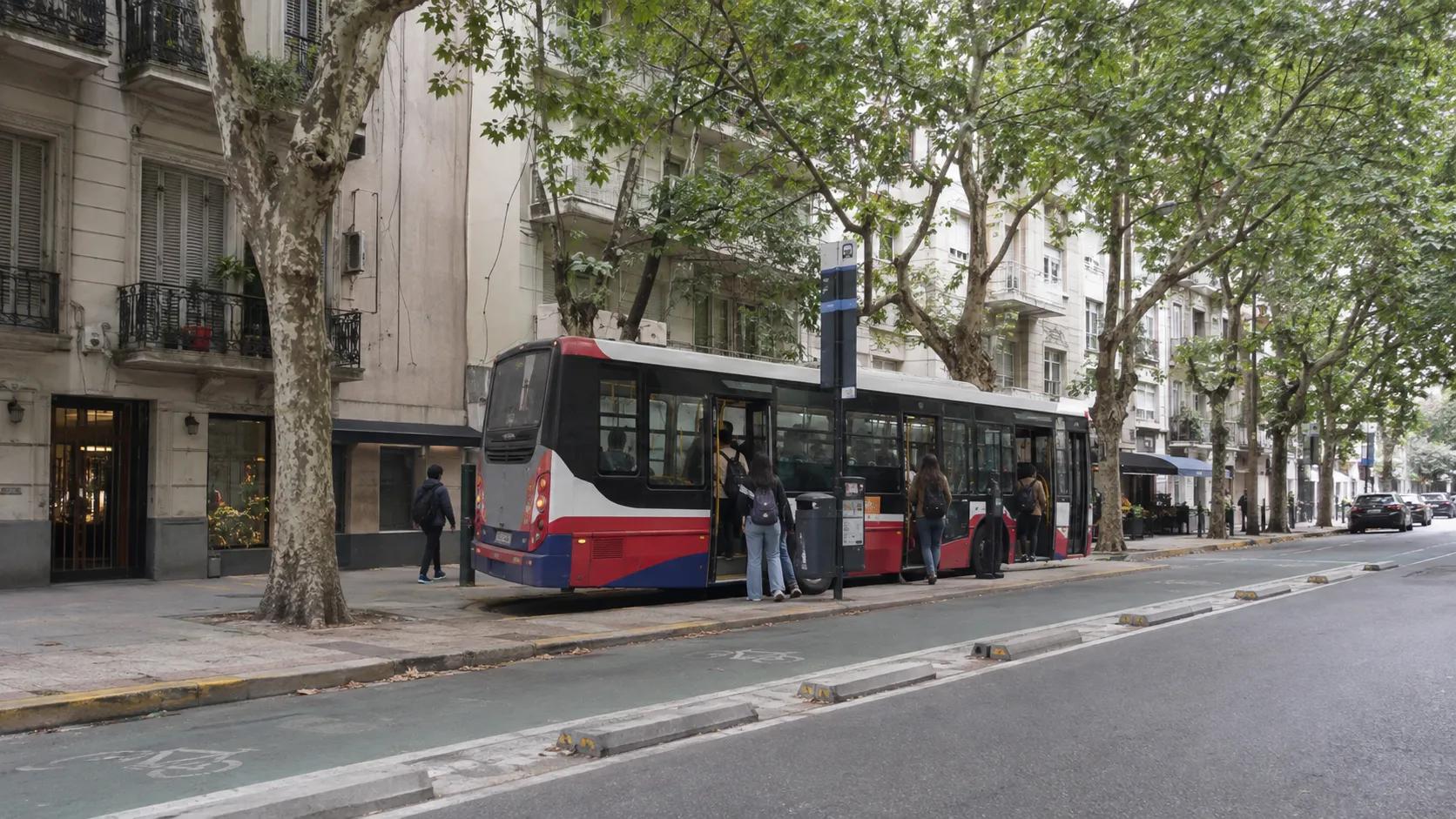
In Buenos Aires you get around by Subte, the metro, and above all by colectivo, the bus. With a registered SUBE card, a Subte ride costs 1,753 pesos (€1) and a short colectivo ride about 888 pesos (€0.51). The Subte and some colectivos also take contactless bank cards and QR. Fares are adjusted almost every month, and Ecobici bikes are paid for anyone without Argentine residency. To get a feel for daily life in the city, see also student life in Buenos Aires.
1. The network at a glance
Three modes of transport cover the city and its suburbs, with a single payment system.
- The Subte: the metro, with lines A, B, C, D, E and H, plus the Premetro. It covers the centre, Palermo, Recoleta, San Telmo and the Abasto well.
- Colectivos: the buses, more than a hundred lines that go everywhere and are the real backbone of getting around the city.
- Trains: the suburban lines (Mitre, Sarmiento, Roca, San Martín, Belgrano), useful for getting out of the city.
For journey planning, the official Cómo Llego app, Moovit and Google Maps show colectivo lines and stops in real time.
2. The SUBE card
SUBE is the rechargeable travel card used on the Subte, colectivos and trains. You can buy it without any ID at kiosks, Subte stations and SUBE centres, and top it up at kiosks, often in cash.
The one thing not to miss: register it in your name. Unregistered, every ride costs noticeably more. With a foreign passport, registration is done at a SUBE service centre, and there is one at Ezeiza airport, so you can sort it out as soon as you land. Once registered, the card can also be blocked and its balance recovered if you lose it.
Registering your SUBE in your name takes a few minutes at the Ezeiza centre when you arrive, and you pay the standard fare all semester instead of the higher one.
Matthieu, cofounder of Flatmaters3. Paying without SUBE: bank card and QR
Buenos Aires has opened its transport to other ways of paying. Every Subte station accepts contactless Visa and Mastercard debit, credit and prepaid cards, as well as compatible phones and watches and QR payments. Some colectivos fitted with the new readers accept them too.
It is handy in your first days, before you have a SUBE. Just check that your foreign card is enabled for contactless and look at your bank's fees on payments in pesos. For a whole semester, a registered SUBE is still the easiest option day to day, especially on colectivos that do not have the new readers yet.
4. What a journey costs
These are the current fares with a registered SUBE. In Argentina they are adjusted almost every month, so keep the order of magnitude in mind rather than the exact figure.
| Journey (registered SUBE) | Fare |
|---|---|
| Subte, one ride | 1,753 ARS (€1) |
| City colectivo, up to 3 km | 888 ARS (€0.51) |
| City colectivo, 3 to 6 km | 987 ARS (€0.56) |
| City colectivo, 6 to 12 km | 1,063 ARS (€0.61) |
| City colectivo, over 12 km | 1,139 ARS (€0.65) |
| Suburban train, minimum fare | 480 ARS (€0.27) |
Colectivo lines heading out into the province have their own, higher fares. For your overall budget, see our article on the cost of living in Buenos Aires.
Browse the rooms available for your semester and check the nearest Subte or colectivo line before you book.
See housing in Buenos Aires5. Colectivos day to day
The colectivo is the most widely used form of transport in Buenos Aires, and it goes where the Subte does not. You catch it at a stop marked with the line numbers, flagging down the driver. You get on at the front, say your destination if the fare depends on distance, then tap your card.
Many lines also run at night, which makes them the cheapest way to get home late. Uber, Cabify and DiDi are widely used too, especially when a few people split the fare.
6. Ecobici and cycling
Buenos Aires has an extensive network of cycle lanes in the city and a bike-sharing scheme, Ecobici. It is free on weekdays for residents of Argentina, but paid for anyone without residency, which is the case for most exchange students.
| Ecobici pass without Argentine residency | Fare |
|---|---|
| One ride of up to 45 minutes | 2,100 ARS (€1.20) |
| 24-hour pass, rides of up to 90 minutes | 15,000 ARS (€8.57) |
You sign up in the BA Ecobici app, then unlock a bike by scanning the QR code on the handlebars. Riding through the Palermo parks or along the Costanera is also a good way to discover the city.
To book your future room from home, everything is explained on how it works, and you can find out who we are on the about page.
7. Frequently asked questions
How much is the Subte in Buenos Aires?
1,753 pesos (€1) per ride with a registered SUBE card. Unregistered, a ride costs more. Fares are adjusted almost every month.
Can a foreigner get a SUBE card?
Yes. You can buy one without ID at kiosks and Subte stations. To register it in your name with a foreign passport, go to a SUBE service centre, such as the one at Ezeiza airport.
Can I pay for the Subte with a foreign bank card?
Yes, every station accepts contactless Visa and Mastercard cards, phones and QR. Some colectivos do too. Check that your card is enabled for contactless and look at your bank's fees.
Is Ecobici free for exchange students?
No, unless you hold Argentine residency. Without residency, a 45-minute ride costs 2,100 pesos (€1.20) and the 24-hour pass 15,000 pesos (€8.57).
How do I get home late at night in Buenos Aires?
Many colectivo lines run at night, and it is the cheapest option. Uber, Cabify and DiDi are also widely used, especially in a group.