

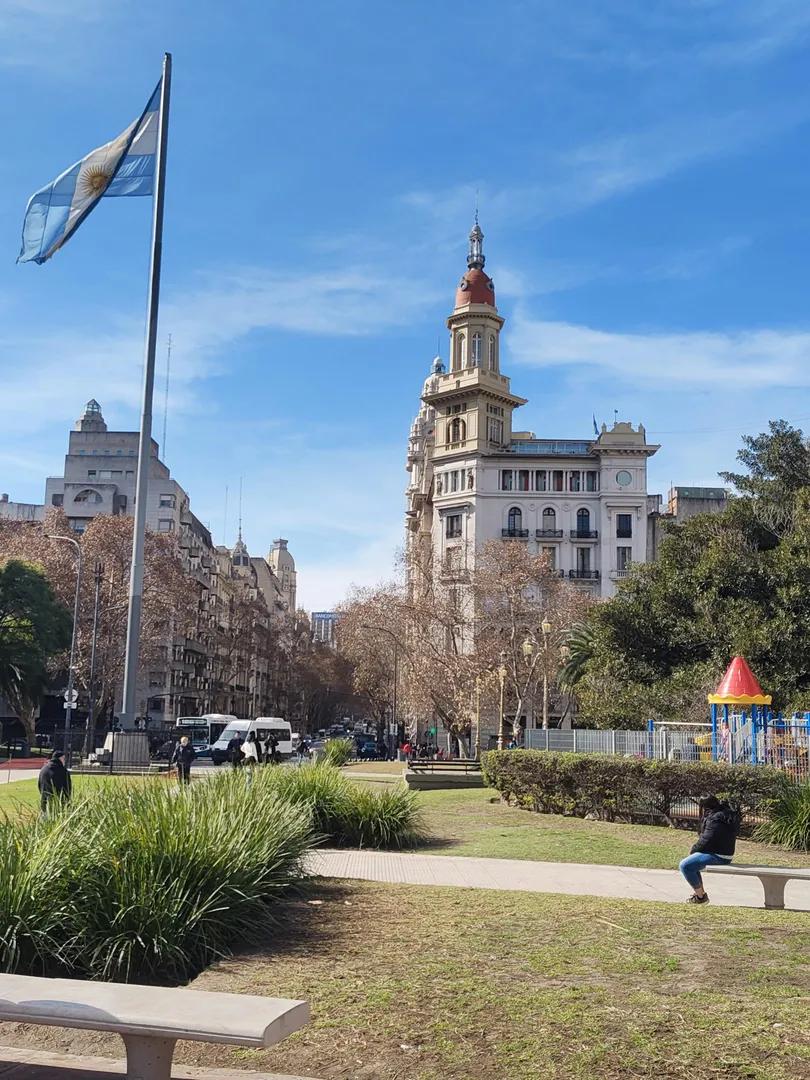
According to Argentina's foreign ministry, more than 50,000 international students choose Argentina every year for all or part of their studies. Buenos Aires concentrates the vast majority of them: the capital is ranked the #1 student city in Latin America by the QS Best Student Cities ranking, and Argentine universities, public and private, hold agreements with most major European institutions.
This guide brings together everything you need to know before heading to Argentina in 2026: visa procedures, an overview of the universities, cost of living, housing and the first days on the ground. It is up to date for spring 2026, particularly on the question of cost of living, which has shifted significantly since the Argentine peso stabilised in late 2023.
Why study in Argentina in 2026
Argentina is the second-largest Spanish-speaking economy in South America, and the continent's leading university destination after Brazil for international students. Its university system combines a top-quality, tuition-free public university (UBA) with a highly internationalised private ecosystem.
Three concrete reasons push international students to choose Argentina:
- Immersion in Rioplatense Spanish. Argentina has its own Spanish, with the use of vos instead of tú, an accent shaped by Italian influence and a unique lexicon. After one semester, your ear adjusts and you leave with a Spanish that works directly across the southern cone of Latin America.
- Buenos Aires as a global city. 3 million inhabitants in the federal capital (CABA), 15 million in the metropolitan area. European architecture, a dense cultural scene (tango, theatre, literature, independent music), legendary bookshops such as the Ateneo Grand Splendid, and a porteño café on every corner.
- A recognised university system. UBA (Universidad de Buenos Aires), public and tuition-free, is consistently ranked among the top universities in Latin America. Private business schools (UTDT, UdeSA, UCA) hold strong reputations. Exchange agreements with Western European institutions are extensive.
Note: Argentina has just been through a turbulent economic period with the Milei government's reforms from late 2023 onwards. The peso stabilisation policy has reduced inflation but also brought Argentine prices closer to international levels. Budget figures from blogs written in 2021-2023 are no longer relevant in 2026: we cover the current numbers in detail further down.
The Argentine universities to know
Here are the universities that welcome the most international exchange students. No ranking: each one has its own identity.
Universidad de Buenos Aires (UBA)
Founded in 1821, UBA is the largest university in Argentina and one of the largest in Latin America (over 300,000 students). A public university, tuition-free for both Argentine and international students. Faculties are spread across the city: Ciudad Universitaria in the north (sciences, architecture), Económicas near Plaza Italia, Derecho in Recoleta, Filosofía y Letras in Puán (Caballito), Sociales in Constitución. Open to exchange students through agreements with European universities.
Pontificia Universidad Católica Argentina (UCA)
A private Catholic university founded in 1958, main campus in Puerto Madero (the redeveloped modern port district). Recognised in law, economics, political science, communication and international relations. A structured International Students programme, with courses in Spanish and a few in English. Many partnerships with European institutions such as Sciences Po, EDHEC and IÉSEG.
Universidad Torcuato Di Tella (UTDT)
A private university founded in 1991, single campus in Belgrano (modern architecture by Rafael Viñoly). Highly selective, research-driven. Flagship programmes: economics, finance, political science, history and architecture. Several full programmes are available in English, making UTDT one of the few Argentine institutions where a student can complete a full semester without speaking Spanish. Agreements with HEC, ESCP, Sciences Po and Bocconi.
Universidad de San Andrés (UdeSA)
A private university founded in 1988, main campus in Victoria (northern suburbs) and a satellite in Parque Patricios. Small (under 5,000 students), with a liberal arts atmosphere. Strong reputation in economics, political science, international relations and communication. Active Study Abroad programme.
Universidad de Palermo (UP)
A private university founded in 1986, with a large campus in the Palermo neighbourhood (where its name comes from). Strongly oriented towards design, communication, architecture, art, psychology and hospitality management. Open and international atmosphere. Many partnerships with European design and communication schools.
Other universities to know
UADE (Universidad Argentina de la Empresa) is a large private university with a wide offer in business, engineering and communication. ITBA (Instituto Tecnológico de Buenos Aires) is the reference for private engineering. Universidad Austral (Pilar campus, northern suburbs) is recognised in business (IAE Business School) and medicine. UNTREF (Universidad Nacional de Tres de Febrero) and UNSAM (Universidad Nacional de San Martín) are two recent public universities with active international programmes.
Are public universities free for international students in Argentina?
Yes. Public universities in Argentina, including UBA, are tuition-free for international undergraduate students. There are no nationality or residency restrictions on free undergraduate tuition. International students only pay minor administrative fees (translation, apostille, registration). Postgraduate programmes (master's, MBA, PhD) can carry tuition fees, even at public universities.
That makes UBA one of the most accessible top-100 Latin American universities in the world for international students. A full undergraduate degree at UBA costs essentially nothing in tuition, against USD 4,000-15,000 per year at private institutions in Argentina, or several times that at most universities in the UK or Western Europe.
The fine print
Free tuition does not mean free studies: you still cover housing, food, transport and books, plus apostille and translation costs for incoming documents. A monthly budget of EUR 800-1,500 (£690-£1,290 / $880-$1,650) is realistic for a UBA student in Buenos Aires in 2026.
Argentine visa: tourist, prórroga, student
Up to 90 days: the automatic tourist permit
No formal student visa is needed for citizens of the European Union, the United Kingdom, the United States and many other countries. You enter Argentina with an automatic tourist permit on arrival, valid for 90 days. That is enough for a summer school, a short term or the start of a semester.
From 90 to 180 days: the prórroga
The tourist permit can be extended once on the ground via the prórroga, requested online on the Dirección Nacional de Migraciones (DNM) website. It adds 90 extra days for around USD 30. This is the option chosen by most exchange students whose semester slightly exceeds the initial 90 days.
Beyond 180 days: the student visa
For longer programmes (full year, undergraduate, master's), the student visa (visa transitorio de estudiante, category D, valid 365 days and renewable) is the official route. It is requested at the Argentine consulate in your country of residence before departure. Average processing time is 4 to 8 weeks: plan at least 2 to 3 months ahead of arrival.
The student visa carries one major advantage compared with the Chilean equivalent: it allows international students to work up to 20 hours per week during term time, and full-time during university holidays. Plenty of porteño students take part-time jobs in cafés, language schools or tech start-ups while they study.
The documents typically required for the student visa application:
- Official acceptance letter from the Argentine university (UBA, UCA, UTDT, UdeSA, UP, etc.)
- Proof of financial resources (bank statements in your home country, scholarship, notarised parental sponsorship)
- Criminal record extract, translated and apostilled
- Birth certificate, apostilled and translated by a sworn translator
- Medical certificate
- Passport-size photos
- Passport valid at least 6 months beyond the planned return date
- Consular fees (typically EUR 150 to 250 / £130-£215 / $165-$275 depending on the year)
Good to know
The exact list and fees vary by year and bilateral agreement. Before launching your application, confirm everything on the official website of the Argentine consulate in your country of residence. Argentine consular procedures change regularly: forum threads and old blogs are often outdated.
Cost of living in Buenos Aires in 2026
This is the section to read carefully in 2026. Since the Argentine peso stabilised in 2024, Buenos Aires is no longer the bargain student city it was up to 2022-2023. Several 2026 sources place the cost of living in Buenos Aires at roughly 10 to 15 percent below a typical Western European student city, against 30 to 40 percent three years ago.
Here is a realistic monthly budget for a student in Buenos Aires in 2026, excluding tuition:
- Rent. EUR 400 to 850 (£345-£735 / $440-$935) depending on the format and area (room in a shared flat: EUR 400-600 / £345-£515 / $440-$660 ; furnished studio in Palermo or Recoleta: EUR 650-850 / £560-£735 / $715-$935)
- Groceries. EUR 180 to 280 (£155-£240 / $200-$310)
- Public transport. EUR 25 to 50 (£22-£43 / $28-$55) using the SUBE rechargeable card, valid on the Subte, colectivos and trains
- Going out, leisure, restaurants. EUR 130 to 230 (£110-£200 / $145-$255)
- Phone and internet. EUR 5 to 10 (£4-£9 / $5.50-$11)
- Extras and unexpected costs. EUR 50 to 100 (£43-£85 / $55-$110)
Total: between EUR 800 and 1,500 per month (£690-£1,290 / $880-$1,650) depending on lifestyle. Most international students we host live comfortably on around EUR 1,000-1,200 per month in Buenos Aires in 2026, including a few weekends in Tigre or Mar del Plata.
The Argentine peso in 2026
Up until late 2023, Argentina ran a dual exchange-rate system with a "dollar blue" that let tourists and expats swap their euros and pounds at a much better rate. That gap has largely vanished. Today, the official exchange rate is close to the parallel rate, and most payments go through normally in pesos (ARS), via European bank cards or in cash. Visa and Mastercard work everywhere. Inflation has come down sharply but remains higher than in the UK or eurozone: prices still move quickly, so check before departure.
Finding student housing in Buenos Aires
From experience, this is the most stressful step for an international student arriving in Buenos Aires. The Argentine rental market has its quirks:
- University residences. Underdeveloped in Argentina, except for some private universities outside the centre (Austral in Pilar, UdeSA in Victoria). Rarely accessible for exchange students based in central Buenos Aires.
- Standard rental (alquiler). Often requires a garante (a property-owning Argentine guarantor) which international students do not have. Landlords rarely accept short leases.
- Shared flats and alquiler temporario. The dominant option for international students. Rents paid in pesos or in USD depending on the landlord, flexible 3-12 month contracts. This is where most listings circulate, but also where most scams happen.
- Facebook groups and classified sites (ZonaProp, Mercado Libre Inmuebles, "Alquileres Estudiantes Buenos Aires" groups): many listings, little verification. Risk of scams, verbal contracts and misleading photos. Handle with care if you are searching from abroad.
- Specialised platforms such as Flatmaters: every Buenos Aires home is visited, every landlord verified, contracts drafted by us. Pay from your home bank account by international transfer, no need to open an Argentine account.
See our verified housing in Buenos Aires
Flats, shared homes and studios in Palermo, Recoleta, Belgrano, Villa Crespo and Caballito, all visited by our team.
Find my housingBe cautious of listings with abnormally low rents: they often hide run-down or poorly maintained properties, and many international students end up moving home a few weeks in. A slightly higher rent on a verified, decent-quality home almost always beats a Facebook deal that turns out to be a scam or an unliveable flat.
Your first days on the ground
Your international flight lands at Ezeiza International Airport (EZE), 35 km southwest of central Buenos Aires. From the airport, your options: the Tienda León bus (around EUR 10 / £9 / $11), an official taxi (EUR 25-40 / £22-£35 / $28-$44 depending on traffic) or Uber/Cabify (often cheaper than the official taxi). Students arriving on intra-Latin American exchanges may also land at Aeroparque Jorge Newbery (AEP) right in the centre, much closer.
For the first 7 days, here is the checklist to plan:
- Day 1. Arrival at the home, walk-through, key handover.
- Days 2-3. Argentine SIM card (Personal, Claro or Movistar): budget EUR 5 to 10 / £4-£9 / $5.50-$11 per month with data. Activated in store with passport.
- Days 2-4. SUBE card (Sistema Único de Boleto Electrónico), required for the Subte, colectivos and trains. Buy one in metro stations, kiosks or some petrol stations. Around EUR 3-5 empty, then top up.
- Weeks 1-2. Start of term, campus tour, first lectures and first encounters with porteño life.
Buenos Aires is the most European-feeling city in Latin America: for an international student, it is both disorienting and oddly familiar at the same time. The first two weeks are intense, then the city opens up in one go. The café on the corner, the Thursday peña, the rush-hour Subte, dinners that start at 10 pm and nights out that begin at 1 am: all of it settles in within a few weeks.
Matthieu, co-founder of FlatmatersFrequently asked questions
Are public universities in Argentina free for international students?
Yes. Public universities in Argentina, including UBA, are tuition-free for international undergraduate students. There are no nationality or residency restrictions on free tuition. International students only pay minor administrative fees (translation, apostille, registration).
Postgraduate programmes (master's, MBA, PhD) can carry tuition fees, even at public universities.
Can I work in Argentina with a student visa?
Yes. The Argentine student visa (visa transitorio de estudiante, category D) allows international students to work up to 20 hours per week during term time, and full-time during university holidays.
This is a key difference compared to Chile, where the student visa does not permit paid work. International students need their DNI (residency card) to be issued formally as employees.
Which Argentine universities welcome international students?
Among the most recognised: Universidad de Buenos Aires (UBA) (public), Pontificia Universidad Católica Argentina (UCA), Universidad Torcuato Di Tella (UTDT), Universidad de San Andrés (UdeSA), Universidad de Palermo (UP), ITBA, UADE and Universidad Austral.
All have agreements with many European universities.
Is Argentina safe for international students?
Argentina is generally safe for international students, especially in residential Buenos Aires neighbourhoods (Palermo, Recoleta, Belgrano, Caballito).
As in any major city, standard urban awareness applies: avoid flashing your phone on public transport, do not walk alone at night in some outer districts, and prefer Uber or Cabify over an unofficial taxi. The vast majority of international students complete their stay without incident.
How much does student life in Buenos Aires cost in 2026?
The cost of living in Buenos Aires has risen sharply since the Argentine peso stabilised. A realistic monthly student budget now sits between EUR 800 and 1,500 (£690-£1,290 / $880-$1,650) including rent, depending on lifestyle.
That is roughly 10 to 15 percent below a typical Western European student city, compared to 30-40 percent a few years ago. Rents in Palermo and Recoleta have risen the most.
Can you study in Argentina without speaking Spanish?
Yes. Several private universities (UTDT, UdeSA) offer programmes taught in English, especially in business and economics. For programmes taught in Rioplatense Spanish, an A2-B1 level is enough to start: immersion progresses quickly on the ground.
The CELU (Certificado de Español Lengua y Uso) is the official Argentine Spanish test; the DELE is also accepted by most universities.