

Buenos Aires is a world capital sitting on the Río de la Plata: 3 million people in the city itself (CABA, Ciudad Autónoma de Buenos Aires), 15 million in the wider metro area. For an exchange student, it is a rare playground: very high cultural density, nightlife that never stops, varied architecture (Haussmann meets art deco meets modernism) and a university scene that draws around 90,000 international students every year.
Buenos Aires, first contact
What surprises most people on arrival: the city looks like a European capital. Haussmann transplanted to Palermo. Boulevards in the Champs-Élysées style (Avenida 9 de Julio), five-storey bookshops, historic cafés where Borges used to write. Argentines themselves often describe BA as "the most European city in Latin America".
Climate and seasons
Buenos Aires runs on a southern-hemisphere calendar. Four clearly marked seasons:
- Summer (December to March): hot and humid, 20 to 35 °C. Humidity can be crushing in January and February. Air conditioning is essential.
- Autumn (April to June): mild and bright, 10 to 25 °C. One of the most beautiful times of year.
- Winter (June to September): cool and grey, 6 to 15 °C. Rarely below zero, no snow, but the damp makes it feel colder. Many older buildings are poorly insulated: plan for a portable heater.
- Spring (September to November): changeable, 10 to 25 °C, occasional thunderstorms. The city blooms again in the parks.
The city, an overview
Buenos Aires is divided into 48 official barrios (neighbourhoods). For an exchange student, around a dozen of them concentrate daily life: Palermo, Recoleta, Belgrano, Villa Crespo, Chacarita, Colegiales, Caballito, Almagro, San Telmo, Núñez, Puerto Madero, Microcentro. You will probably never need to know the others on a daily basis.
The city's neighbourhoods
Each one has its own atmosphere, presented without ranking.
Palermo
The largest of the neighbourhoods popular with international students. Subdivided into several sub-areas: Palermo Soho (boutiques, design cafés, Plaza Serrano), Palermo Hollywood (bars, audiovisual production), Palermo Chico (upmarket residential close to the museums), Palermo Viejo (the most historic). Vast parks (Bosques de Palermo, Rosedal, Jardín Japonés), cosmopolitan vibe, dense nightlife.
Recoleta
A historic residential neighbourhood, centred on the Recoleta Cemetery (where Eva Perón rests). Grand Haussmann-style buildings, classic bookshops and cafés (the Ateneo Grand Splendid), the Recoleta Cultural Centre, MALBA a few minutes away. Less bohemian than Palermo, quieter.
Villa Crespo, Chacarita, Colegiales
Three neighbourhoods that have been transforming over the past decade, very popular with Argentine students and young professionals. Specialty bars, fab labs, covered markets (Mercado de Belgrano), residential atmosphere with a creative edge. Often more accessible on rent than Palermo or Recoleta.
Belgrano
Residential and leafy, Belgrano hosts several university campuses (UTDT, UBA Escuela de Estudios Orientales). Wide avenues (Cabildo), parks, direct access to Subte line D. A neighbourhood favoured by students who want to live calmly while staying connected to the centre.
San Telmo
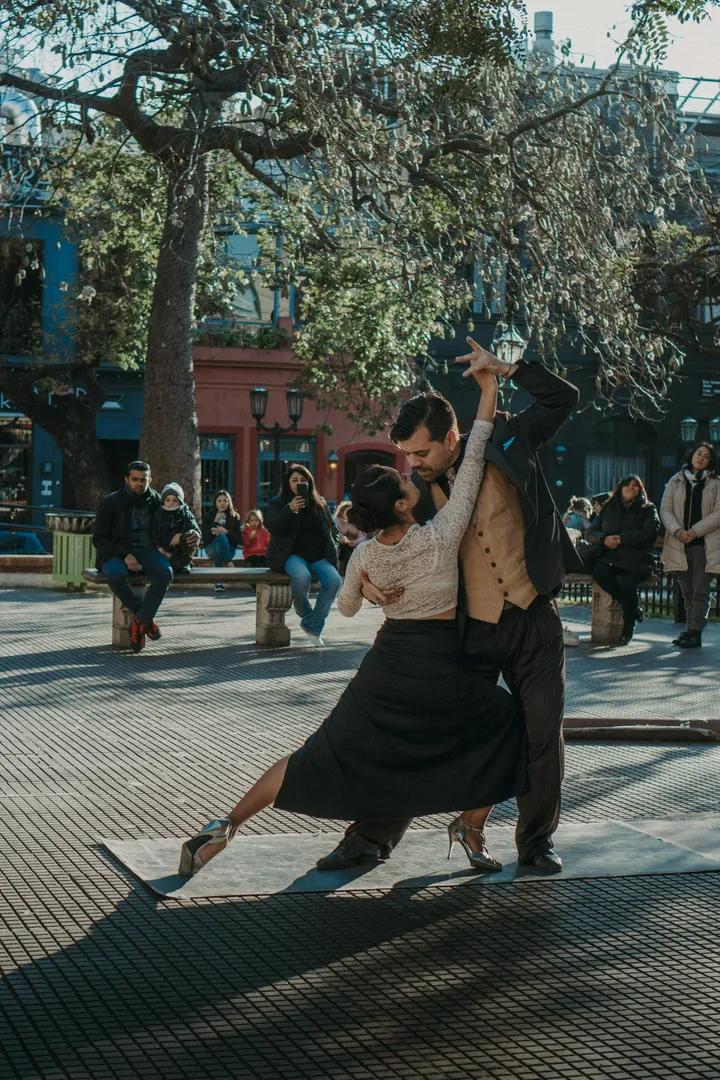
The most historic. Cobbled streets, colonial architecture, the Feria de San Telmo every Sunday on Plaza Dorrego (antiques market and street tango). Bohemian, touristy, alive. In the evening, the Plaza Dorrego / Defensa axis stays the heart of the action.
Caballito
A more family-oriented and student neighbourhood, at the geographic heart of the city. Close to UBA's Facultad de Filosofía y Letras (Puán) and the Parque Centenario. More accessible cost of living, more local vibe.
Puerto Madero
An old industrial port reconverted into a modern neighbourhood with skyscrapers, landscaped waterfront, restaurants and the UCA campus. Very modern, mostly upmarket residential.
Microcentro, Abasto, Barrio Norte
The Microcentro is the administrative and financial heart (Casa Rosada, Plaza de Mayo, Obelisco). Very busy in the daytime, quieter in the evening. Abasto is tied to the memory of tango (Carlos Gardel grew up there). Barrio Norte, next to Recoleta, is an upmarket residential area.
Getting around Buenos Aires
The Subte
The Buenos Aires metro is the oldest in Latin America (1913). 6 lines (A, B, C, D, E, H) plus the Premetro. It covers the centre and most major neighbourhoods well. Frequency: 3 to 6 minutes at peak hour. Service runs from around 5-6 am to 10-11 pm. A single ride costs only a few pence. The SUBE card is mandatory.
The colectivos (buses)
More than 150 bus lines cover absolutely every part of the city, most of them 24 hours a day. The colectivo is the dominant urban transport for porteños. The BA Cómo Llego app or Google Maps give real-time routes. Payment is by SUBE only.
Suburban trains
To leave the CABA: Sarmiento (west, towards Ciudad Universitaria UBA), Mitre (north, towards Tigre, San Andrés), Roca (south), San Martín (west). Fares are very low. Useful for weekends out of town.
The SUBE card
The universal transport card, available at kiosks, Subte stations or SUBE service points. Top up in cash or via the SUBE app. Students with a DNI can apply for the tarifa social (social fare) which lowers prices further.
Good to know
Get your SUBE card within 48 hours of arrival. Without it, you cannot use the Subte, the buses or the trains. You can find one at large kiosks, central stations or the Centro de Atención SUBE under the Obelisco.
Uber, Cabify, DiDi
All these apps work in Buenos Aires. Uber and Cabify are the most common. Fares are accessible: a Palermo to Microcentro Uber costs around EUR 3 to 6 (roughly £2.50-£5 / $3.30-$6.60). Always prefer these apps over an unofficial taxi, especially at night.
The porteño student rhythm
Argentine university semesters follow the southern academic calendar: first semester runs from mid-March to early July, second semester from early August to mid-December. Summer holidays fall in the southern summer, from mid-December to mid-March.
Class days
Lectures run from 8 am to 10 pm, often with a lunch break between 1 pm and 3 pm. Timetables are fragmented: a student rarely has more than three classes a day, but they can be spread out. Some UBA programmes offer evening classes (6-10 pm) to accommodate students who work.
The social rhythm
Argentines eat dinner late: anything before 9 pm is considered the kids' hour. Most porteños sit down to eat at 9-10 pm or even later. Student parties rarely start before midnight and run through to dawn. The previas (pre-parties) at home are a ritual. At weekends, Sunday asados (Argentine barbecue) bring family and friends together for 3 to 4 hours.
Eating and drinking in Buenos Aires
The essentials
- Asado: the central tradition, grilled beef, chorizo, morcilla, entrañas, tiras de asado. An asado is a 3 to 5 hour meal shared with family or friends.
- Argentine empanadas: crisp pastry filled with beef (carne), chicken (pollo), ham and cheese, or sweetcorn. The best often come from the provinces (Salta, Tucumán).
- Milanesa: a breaded escalope, served with chips, mash or rice. The everyday student meal.
- Pizza porteña: Italian-influenced, thick crust (fugazzeta, muzzarella, napolitana). Several century-old institutions: Guerrín, Las Cuartetas, Banchero.
- Medialunas: sweet or savoury croissants, inseparable from the porteño breakfast.
- Dulce de leche: unavoidable, in alfajores, ice creams, pancakes.
- Mate: the national infusion, passed around in turns. You will end up drinking it too.
Eating out
The parrilla (Argentine grill) is the institution: Don Julio in Palermo, La Brigada in San Telmo, El Pobre Luis in Belgrano, and dozens of more modest ones. The bodegones are traditional taverns serving family cooking at moderate prices. The Italian cantinas (La Boca, Colegiales) are a legacy of the massive Italian immigration of the 19th and 20th centuries.
Groceries and markets
The big chains: Coto, Día, Carrefour Argentina, Jumbo. Covered markets (Mercado de San Telmo, Mercado de Belgrano, Mercado de Bonpland) combine fresh produce and food stalls. Local verdulerías (greengrocers) and carnicerías (butchers) are often cheaper than the supermarkets.
Going out: bars, milongas, clubs
Bars and historic cafés
Palermo Soho and Hollywood concentrate most of the cocktail bars and rooftops. In Villa Crespo and Chacarita, the scene is more artisan (wine bars, microbreweries). The historic cafés (Café Tortoni, La Biela, Los 36 Billares) are porteño institutions in their own right.
Milongas and tango
Tango in Buenos Aires is still very much alive. The milongas (tango social dance evenings) take place every night across dozens of venues: La Catedral (Almagro), Salón Canning (Palermo), El Beso (Microcentro). Many are open to beginners, often with a drop-in class at the start of the evening (around EUR 10 to 15 / £8.50-£13 / $11-$16.50 for class plus entry). You do not need to be a pro.
Clubs and music scene
The Argentine electronic scene is one of the most vibrant in Latin America. The big clubs (Crobar, Niceto, Club Uniclub) host regular nights. Niceto Club (Palermo) programmes as much indie rock as electronica. The Lollapalooza Argentina festival in March is a major fixture.
Fútbol
An essential piece of porteño life. Boca Juniors (La Bombonera stadium, La Boca neighbourhood) and River Plate (El Monumental, Núñez) are the two historic giants. Going to a match is an intense experience: several agencies offer secure packages designed for visitors.
Culture and events
Museums and cultural venues
- MALBA (Museo de Arte Latinoamericano): in Palermo, an outstanding collection of 20th-century Latin American art.
- Bellas Artes (Museo Nacional de Bellas Artes): free, in Recoleta.
- Teatro Colón: one of the world's leading opera houses, near the Obelisco. Guided tours recommended.
- Ateneo Grand Splendid: a former theatre converted into a bookshop, regularly listed among the most beautiful in the world.
- Museo Evita: in Palermo, dedicated to Eva Perón.
- Centro Cultural Kirchner (CCK) and Centro Cultural Recoleta: free programmes throughout the year.
Annual events
- Feria del Libro de Buenos Aires (April-May): one of the largest book fairs in Latin America.
- BAFICI (Festival Internacional de Cine Independiente): April.
- Festival Internacional de Tango (August): milongas, concerts, films.
- Lollapalooza Argentina: March.
- Noche de los Museos (November): one night, all museums free.
Adjusting to rioplatense Spanish
The Spanish spoken in Buenos Aires is its own variant: people use vos instead of tú (with its own conjugation: vos tenés instead of tú tienes), the accent is heavily marked by Italian (a legacy of mass immigration in the 19th and 20th centuries), and the sh sound replaces the ll and y (calle sounds like "casheh"). It is known as castellano rioplatense.
A few words to know
- Che: an interjection meaning "hey, you" (the origin of the nickname given to Ernesto Guevara)
- Boludo: "mate" (affectionate between friends, an insult out of context)
- Pibe / piba: young man / young woman
- Laburo: work, job (from the Italian lavoro)
- Quilombo: a mess, chaos
- Bárbaro / genial: great, awesome
- Re: an intensifier prefix (re lindo = really pretty)
- Mina: girl (slang)
The first weeks in Buenos Aires, the vos, the che and the sh sound throw off even people who arrive with solid Castilian Spanish. By the end of the first month, you are used to it; by the third, you are speaking porteño without realising. That accent is a real bonus afterwards: working in wine, football or Latin American literature without being instantly read as a foreigner is a lasting asset.
Matthieu, co-founder of FlatmatersFind your student housing in Buenos Aires
Studios, shared flats and apartments in Palermo, Recoleta, Belgrano and Villa Crespo, all vetted by our team.
Find my housingFrequently asked questions
Is Buenos Aires a good city for international students?
Yes. Buenos Aires consistently ranks among the best student cities in Latin America in the QS Best Student Cities Ranking. A very European-feeling capital of 3 million people, with a dense cultural scene (tango, theatre, literature, music), a diverse university offer (free public UBA plus reputable private institutions like UCA, UTDT, UdeSA, UP) and an active international community.
The city welcomes around 90,000 international students every year.
What is the climate like in Buenos Aires?
Buenos Aires has a humid subtropical climate with four clearly marked seasons, reversed compared with the UK and Western Europe. Summer (December-March) is hot and humid (20-35 °C). Autumn (April-June) is mild and pleasant (10-25 °C). Winter (June-September) is cool (6-15 °C, rarely below 0, no snow). Spring (September-November) is bright and changeable.
Many older buildings are poorly insulated: plan for a portable heater in winter.
How do you get around in Buenos Aires?
The Subte (metro) has 6 lines (A, B, C, D, E, H). The colectivos (buses) cover the whole city 24/7. Suburban trains (Sarmiento, Mitre, Roca, San Martín) connect the centre to the wider metro area.
The SUBE card is essential for all of these. Uber, Cabify and DiDi work very well. Walking is often a pleasure, especially in Palermo, Recoleta and San Telmo.
Which neighbourhoods do international students live in in Buenos Aires?
International students spread across several neighbourhoods, each with its own atmosphere. Palermo (Soho, Hollywood, Chico) draws many internationals: leafy streets, cafés, bars, busy nightlife. Recoleta is more residential and classic.
Villa Crespo, Chacarita, Colegiales have a more local, creative feel. Belgrano and Caballito are quieter and family-oriented, close to several university campuses. San Telmo keeps a bohemian and historic atmosphere.
How do you stay safe at night in Buenos Aires?
The neighbourhoods most students live in (Palermo, Recoleta, Belgrano, Villa Crespo, Caballito, central San Telmo) are lively and well-lit in the evening.
As in any large capital, prefer Uber or Cabify over an unofficial taxi, stay on busy streets and keep your phone discreet on the Subte.
How long does it take to settle into life in Buenos Aires?
The first 2 to 3 weeks are intense: admin (DNM, SUBE), adjusting to rioplatense Spanish (the vos, the sheísmo, the porteño accent), finding your way around the neighbourhoods and the Subte lines.
From the first month, daily life settles. The third month is where you really feel integrated: you have your café, your favourite parrillas, your Thursday peña, your group of Argentine and international friends.