

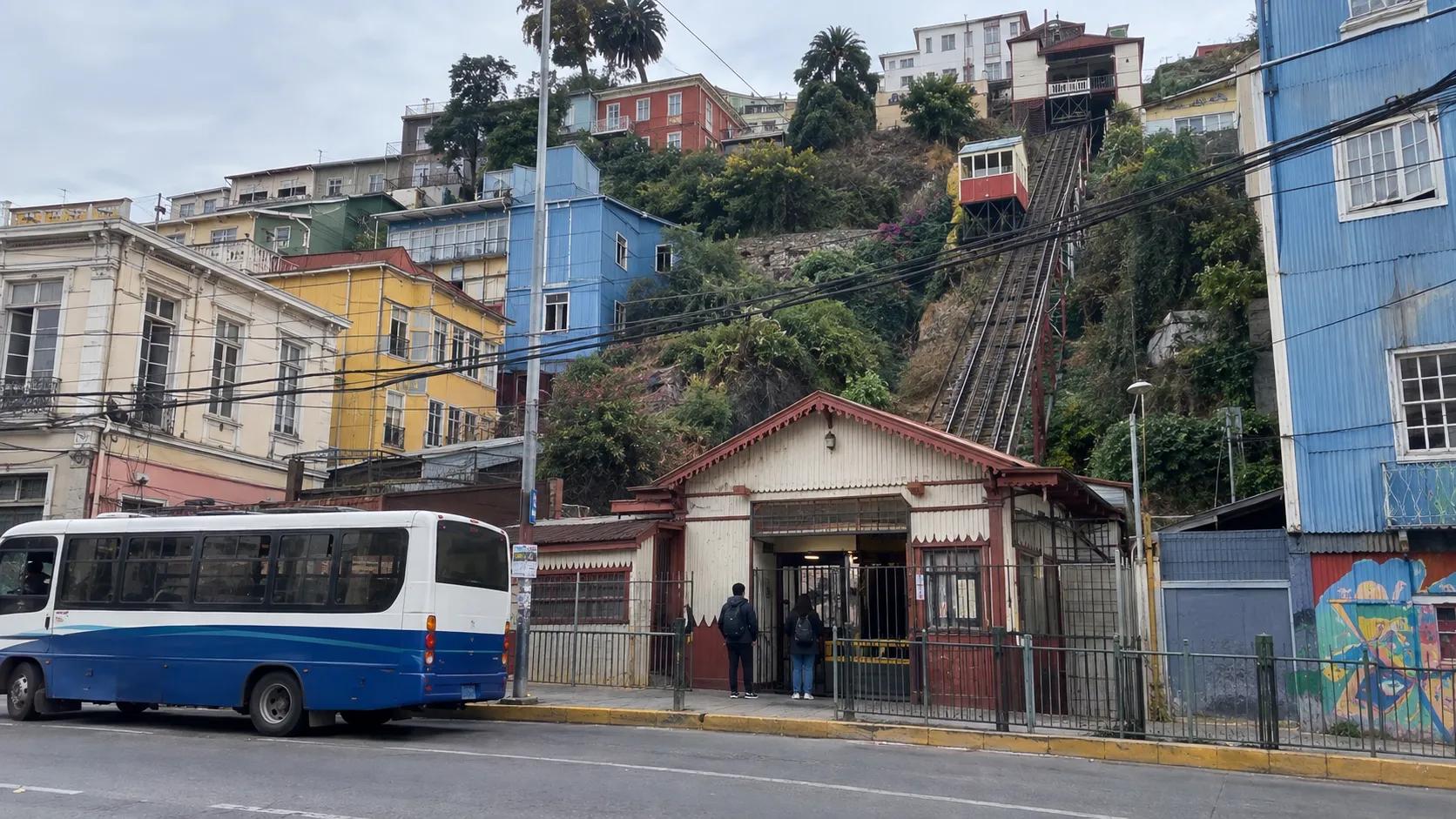
In Valparaíso, the Merval runs along the coast and links the port to Viña del Mar within a single zone A; micros climb the hills for 390 to 840 pesos depending on the route (€0.36 to €0.77) and are cash only; trolleybuses and electric buses run on the flat; and the ascensores, the funiculars, cost 200 pesos (€0.18) at the standard fare. The train, trolleybuses, electric buses and ascensores accept contactless bank cards and QR. To get a feel for daily life in the city, see also student life in Valparaíso.
1. A network built for the gradient
In Valparaíso, the way you travel depends mostly on how high you are going. The city splits between El Plan, the flat strip along the port, and the cerros, the hills rising behind it.
- Along the coast: the Merval, the train linking Puerto to Limache via Viña del Mar.
- On the flat: trolleybuses, electric buses and micros.
- Up the hills: micros, which go everywhere, and ascensores on some of the hills.
For journey planning, Moovit and Google Maps cover the Merval and most micro routes.
2. The Merval, the coastal train
The Merval, officially the Tren Limache-Puerto, is the backbone of travel between Valparaíso and Viña del Mar. And good news for students: every station in Valparaíso and Viña (Puerto, Bellavista, Francia, Barón, Portales, Recreo, Miramar, Viña del Mar, Hospital, Chorrillos, El Salto) is in the same zone A. A trip between the two cities therefore costs the single-zone fare, the cheapest on the network.
The price depends on the time: it is higher at peak time, Monday to Friday from 6:30 to 9:29 and from 16:00 to 19:59, and lower the rest of the time, at weekends and on public holidays. Fares are adjusted every January.
How to pay
The network's standard card costs 3,000 pesos (€2.76), including 500 pesos of credit, from station ticket offices. The train also takes contactless Visa and Mastercard cards, phone wallets and QR, so you can ride from day one without queuing at the ticket office. Just check that your foreign card is enabled for contactless.
3. Micros, for getting up the hills
Micros, the Gran Valparaíso buses, serve every hill, including those without an ascensor. The fare depends on the type of route.
| Type of route | Adult fare |
|---|---|
| Local services | 390 to 450 CLP (€0.36 to €0.41) |
| Hill-to-flat routes | 480 to 640 CLP (€0.44 to €0.59) |
| Direct routes | up to 840 CLP (€0.77) |
Key point: micros are still paid in cash, to the driver. Electronic payment is being phased in, with a trial announced for the first half of 2027. Until then, always carry coins and small notes.
4. Trolleybuses and electric buses on the flat
Valparaíso's trolleybuses, among the oldest still in service anywhere in the world, run through El Plan and are part of the scenery. Alongside them, electric buses link the flat to the Merval stations, including routes E01, E02, E03 and E05.
Unlike micros, trolleybuses and electric buses take contactless bank cards and QR. A discount also applies when you combine modes, for example train and trolleybus, or train and ascensor.
Browse the rooms available for your semester and check how you would get to your campus before you book.
See housing in Valparaíso5. The ascensores
The ascensores are the funiculars linking El Plan to the hills. Locals use them as much as visitors, and several run every day: Barón, Concepción, Cordillera, El Peral, Reina Victoria, Espíritu Santo and San Agustín.
| Fare | Price |
|---|---|
| Standard fare | 200 CLP (€0.18) |
| Ascensor Concepción | 300 CLP (€0.28) |
| With a bike (Barón and Cordillera) | 600 CLP (€0.55) |
| Foreign tourists | 1,000 CLP (€0.92) |
Students with a valid student card, under-14s and over-60s ride free. Depending on the card you show, you may pay the standard fare, the tourist fare or nothing: ask at the ticket office with your student card.
In Valparaíso, a journey is measured in steps more than in kilometres. Before choosing your room, look at how you would get back up home at night.
Matthieu, cofounder of Flatmaters6. On foot, by bike and ride-hailing
Plenty of journeys are done on foot, especially in El Plan and between neighbouring hills, using the staircases and passageways that connect them. Wear good shoes: the slopes are steep.
Cycling happens mostly on the flat and along the seafront, as the hills are very steep for everyday use. To get home late, once the Merval and the ascensores have stopped, students often use Uber or DiDi and split the fare.
For your full budget, see our article on the cost of living in Valparaíso. To book from home, everything is on how it works, and you can find out who we are on the about page.
7. Frequently asked questions
How much is the Merval between Valparaíso and Viña del Mar?
The single-zone fare, the cheapest on the network, since every station in Valparaíso and Viña is in zone A. The price is higher at peak time, on weekday mornings and late afternoons.
Can I pay for micros in Valparaíso by card?
Not yet. Micros are paid in cash to the driver, between 390 and 840 pesos depending on the route. Electronic payment is announced from 2027. The Merval, trolleybuses, electric buses and ascensores do take contactless bank cards and QR.
How much is an ascensor in Valparaíso?
200 pesos (€0.18) at the standard fare, 300 pesos for the Ascensor Concepción and 1,000 pesos for foreign tourists. Students with a valid student card ride free.
Which ascensores are running at the moment?
Barón, Concepción, Cordillera, El Peral, Reina Victoria, Espíritu Santo and San Agustín are in service. Others are out of service, so it is worth checking before choosing a place on a hill.
Do I need a special travel card in Valparaíso?
Not necessarily. The Merval, trolleybuses and ascensores take contactless bank cards. The network card, at 3,000 pesos with 500 pesos of credit, is still handy day to day. For micros you need cash.