
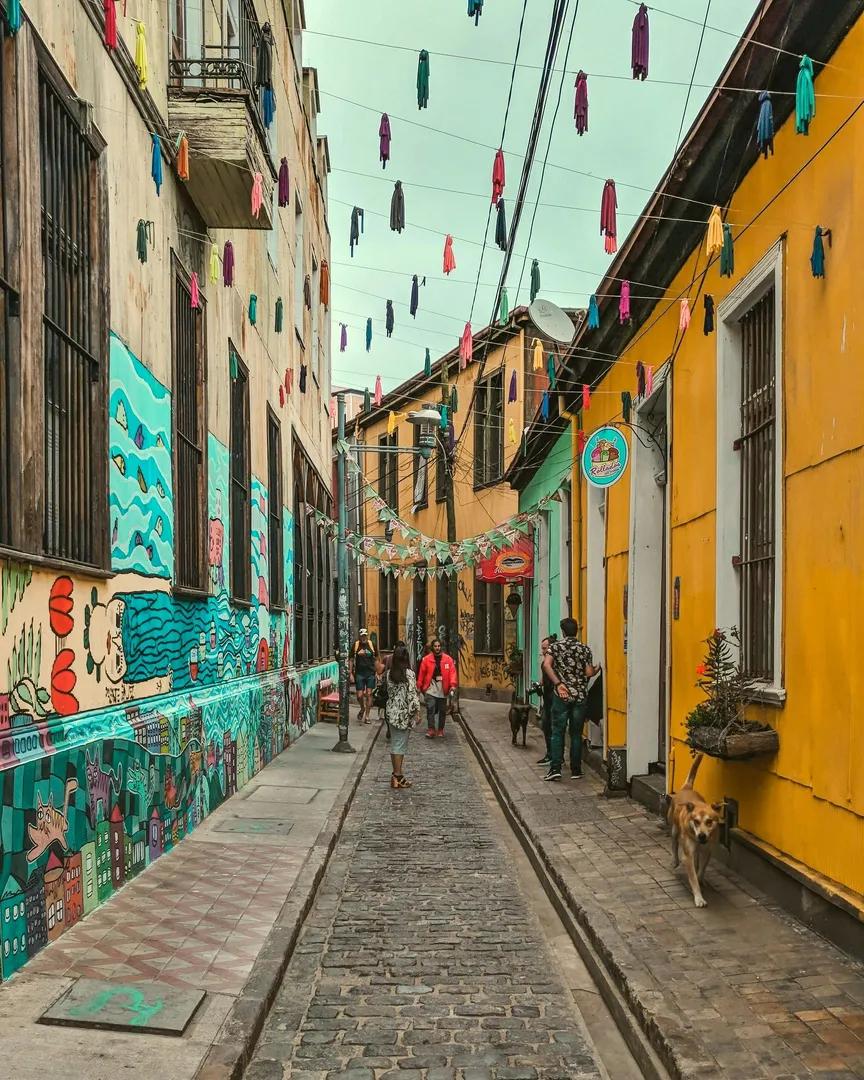
Valparaíso is a city of 280,000 inhabitants built on 44 hills (the cerros) that drop in an amphitheatre down to a bay on the Pacific. The narrow lower belt along the port is called the Plan. Everything else climbs. For a student, the context is disorienting from day one: you learn to navigate by cerro rather than by district, you take an ascensor instead of a metro, and you end up measuring distances in number of staircases.
The pace is noticeably slower than Santiago, with a denser cultural texture per square kilometre. UNESCO listed the historic core as a World Heritage Site in 2003, and that recognition is felt in everyday life: through the murals, the funiculars, the patrimonial palaces still in use.
Valparaíso, first contact
The topography and the cerros
The city is organised on two levels. The Plan runs along the port: straight avenues, administrative buildings, the Cardonal market, universities (the headquarters of the Universidad de Valparaíso, faculties of PUCV, USM offices). Above that, the cerros: 44 hills, each with its own identity, connected to the Plan by staircases, narrow alleys and 15 ascensores still in service (some date from the late nineteenth century).
The cerros most popular with students:
- Cerro Alegre and cerro Concepción. Heritage core listed by UNESCO, painted in vivid colours, full of cafés, galleries and hostels. Artistic and international atmosphere.
- Cerro Bellavista. The cerro of artists and the Museo a Cielo Abierto (open-air street-art museum).
- Cerro Barón. More residential, partly home to the Universidad de Valparaíso, with sweeping views over the bay.
- Cerro Playa Ancha. At the western tip of the city, the UPLA campus. Quieter, student-driven, with its own bars.
- Cerro Los Placeres. The historic USM campus is perched here, with a panoramic view over the port.
- Cerro Cordillera, cerro Florida, cerro Mariposa. Lived-in, a mix of residential life and student presence.
Each cerro has its own character. You will know yours by heart within a few weeks.
Climate and seasons
Valparaíso has a mild oceanic climate, more stable than Santiago's:
- Summer (December to March). 18-24 °C during the day, rarely above 27 °C. Cool, often windy nights.
- Autumn (April-May). 14-20 °C, a soft and sunlit season.
- Winter (June to August). 8-15 °C, with rainy spells. The cerros can become slippery.
- Spring (September-November). 12-20 °C, plenty of late-afternoon sunshine.
One local quirk: the camanchaca, the marine fog that covers the bay on certain mornings, especially in autumn and spring. It almost always lifts by late morning, leaving a clear sky for the rest of the day.
Getting around the cerros
Forget the capital's metro: Valparaíso has none. The city runs on a different combination, micros + colectivos + ascensores = the local rhythm, plus a lot of walking.
On foot and by stairs
Walking is the primary mode. Between neighbouring cerros, it is faster to cut across by staircase than to loop down through the Plan. The historic centre (cerros Alegre and Concepción) is best explored entirely on foot. Bring comfortable shoes: you will walk several kilometres and climb a lot of stairs every day.
The ascensores
Fifteen ascensores (funiculars) are still in service of the 30 the city counted in the twentieth century. The most used: Concepción, Alegre / El Peral, Artillería, Reina Victoria, Barón and Polanco (a one-of-a-kind: you enter through a horizontal tunnel from the Plan, then rise vertically). One trip costs around 500 CLP (roughly EUR 0.50 / £0.45). Several are listed national monuments.
Micros and colectivos
The micros are the local buses: they connect the Plan to the cerros and to the rest of the city. A trip costs 500-700 CLP, payable in cash or with the TNE card (the Chilean student travel card, requires the local carnet de identidad). The colectivos (shared taxis on fixed routes, four passengers max) run on numbered lines and cost between 800 and 1,500 CLP.
The Metro Merval
The Metro Valparaíso (Merval) rail line links the Puerto de Valparaíso station to Limache, passing through Viña del Mar, Quilpué and Villa Alemana. 20 stations. It is the lifeline between Valpo and Viña: 10 minutes station to station, 500-800 CLP. Very practical for students who live in Valparaíso and study in Viña, or the other way round.
Uber, DiDi and intercity buses
Uber works well in Valparaíso, DiDi too. Around EUR 3-7 (£2.50-£6 / $3.30-$7.70) for an intra-city ride. For Santiago, buses leave every 15-20 minutes from the Rodoviario (bus terminal), EUR 8-12 (£7-£10 / $8.80-$13.20) one way, 1h45 of road depending on traffic on Route 68.
The student rhythm in Valpo
As everywhere in Chile, semesters are flipped compared with the northern hemisphere: first semester from March to July, second semester from August to December. Summer university break: mid-December to early March.
A class day
Classes at PUCV, USM and the Universidad de Valparaíso run between 8:30 and 20:00, often with a long lunch break (13:00-15:00). Timetables are more spread out than in Western Europe, with two to four slots per day. Chilean universities generally cluster exchange students' classes onto a few days, which leaves space to travel at the weekend.
Daily student life
Universities organise inter-faculty events regularly: bienvenida at the start of the semester, end-of-semester parties, themed weeks, university sports cup. The vibe is more informal than Santiago: you often run into your professors in cafés on the Plan, classes are smaller, year groups stick together more tightly.
Eating and drinking on the port
Valparaíso is a port city: you will eat fish. A lot of it. The caletas (artisanal fishing wharves) land conger, southern hake, reineta and shellfish every morning. Several restaurants in the Mercado Puerto and on the cerros work directly with the fishermen.
Local specialities
- Chorrillana. The signature dish invented in Valparaíso. Chips + onions + egg + meat, served to share. To try at Bar Inglés or J. Cruz, the institution of the cerros.
- Paila marina. A seafood broth-stew. A port speciality, perfect in winter.
- Caldillo de congrio. Conger soup that Pablo Neruda immortalised in his ode.
- Machas a la parmesana. Razor clams gratinated with parmesan.
- Empanadas de mariscos. Seafood empanadas, the local variation of the national pastry.
- Ceviche. Raw fish marinated in lime juice, a must - you'll find excellent ones in restaurants around the port and the cerros.
Where to shop and eat day to day
The Mercado Cardonal is the main central market, with fruit, vegetables, fish and spices at affordable prices. The Mercado Puerto is smaller, more touristy, with popular cocinerías upstairs. On the supermarket side, you will find Líder, Santa Isabel, Jumbo and Unimarc. For everyday shopping, every cerro has its own almacenes (small neighbourhood grocery shops).
Street art and cultural scene
Valparaíso is one of the world capitals of street art. There is barely a wall in the centre that has not been painted, at least once. The phenomenon is old: cerros Alegre, Concepción and Bellavista hold murals signed by local artists (Inti, Un Kolor Distinto, La Robot de Madera) but also by international muralists invited during festivals.
Museo a Cielo Abierto
On cerro Bellavista, 20 large-format murals painted in the 1970s under a university initiative, scattered through the alleys. The museum is literally open-air: you walk through it as you climb deeper into the neighbourhood. Free, self-guided.
La Sebastiana
One of Pablo Neruda's three houses, perched on cerro Florida. Now a house-museum: you can see the library, the collections, the office overlooking the bay. Paid entry (around EUR 6 / £5 / $6.60), busy on weekends.
Other key cultural venues
- Parque Cultural de Valparaíso (a former penitentiary converted into a cultural space, on cerro Cárcel): exhibitions, theatre, concerts, often free.
- Museo Baburizza (cerro Alegre): fine arts, in an Art Nouveau palace.
- Centro Cultural Palacio Baburizza and Espacio Santa Ana for contemporary exhibitions.
- Teatro Municipal in the Plan for the bigger programmes.
Good to know
Many galleries and cultural centres in Valparaíso are free or charge a token entry. For students, it is one of the richest cultural offers in Latin America when measured against cost. There is no official monthly "free culture" pass, but in practice it is easy to see three to five exhibitions a month without spending a thing.
Going out and unwinding
Bars and cafés
The Plaza Aníbal Pinto, Subida Ecuador and the lower stretches of the cerros Alegre and Concepción hold a good chunk of the nightlife. Cocktail bars in heritage buildings, microbreweries (Cerveza Hoppiness, La Flaca), terrace cafés open late. A drink runs EUR 3-6 (£2.50-£5 / $3.30-$6.60). Evenings start late (rarely before 22:00) and go on until first light.
Clubs and music venues
The electronic and indie rock scene in Valpo is alive: La Piedra Feliz for salsa and tango, Arrecife for electro nights, Ex Trash and La Cucaña for live concerts. Cover charges typically run EUR 5-10 (£4-£9 / $5.50-$11). Special mention for Terraza, one of the most popular clubs among international students: Flatmaters residents get free entry.
Parks and viewpoints
The Paseo 21 de Mayo on cerro Artillería offers the most famous panoramic view over the port. The Muelle Barón is the former industrial pier converted into a seafront promenade. Parque Italia and Plaza Sotomayor are the main squares of the Plan.
Beaches, vineyards and weekends
One of the great advantages of Valparaíso: the surrounding region (the quinta region) is among the densest in Chile in terms of weekend escapes.
Regional beaches
- Viña del Mar. 15 minutes by Metro Merval. Urban beaches (Acapulco, El Sol, Reñaca).
- Concón. Dunes, seafood, 30 minutes by bus.
- Maitencillo, Cachagua, Zapallar. Wilder beaches and small seaside villages, 1h-1h30 to the north.
- Algarrobo, Isla Negra. South side. Isla Negra is home to another Pablo Neruda house-museum.
The Pacific water is cold all year (Humboldt current), but the beaches themselves are stunning and packed during the southern summer.
The Casablanca Valley
The Casablanca wine valley sits 30 minutes from Valparaíso. Famous for its whites (sauvignon blanc, chardonnay), several bodegas offer tours with tastings from EUR 15-25 (£13-£22 / $16.50-$27.50). Small-group bookings are easy through local agencies.
Santiago and the central region
Santiago is 1h45 by bus. Students go back and forth regularly to see other friends, catch a concert or take a domestic flight from SCL airport. In summer, the Andean ski resorts (Valle Nevado, Portillo) are also accessible via Santiago.
Local festivals and traditions
Año Nuevo en el Mar (31 December)
The New Year fireworks fired across the Valparaíso-Viña del Mar bay are one of the most famous in Latin America. Millions gather on the cerros, the docks, the rooftops. Lock the dates in well in advance if you are around in late December.
Festival Internacional de la Canción de Viña del Mar (late February)
The biggest music festival in Latin America, 15 minutes from Valparaíso. A week of international concerts at the Quinta Vergara amphitheatre.
Día del Patrimonio (last Sunday of May)
One day a year when all the heritage buildings of the city (normally closed to the public) open their doors for free. The chance to step inside palaces, ascensor mechanisms, historic consulates.
Fiestas Patrias (18-19 September)
Chile's national holiday. Parks host fondas (open-air party tents), people dance the cueca, eat empanadas and asados. In Valparaíso, Plaza O'Higgins hosts one of the biggest fondas in the region.
Find your student housing in Valparaíso
Rooms in shared houses on the cerros, studios in the Plan, homestays: every option vetted by our team.
Find my housingThe students we host in Valparaíso almost all develop the same attachment to the city. After three months, most know their bakery, their ascensor, their cerro, their bar. Valparaíso is not just its heritage façades: it is a way of life, slower and denser at the same time.
Matthieu, co-founder of FlatmatersFrequently asked questions
Is Valparaíso a good city for an international student?
Yes. Valparaíso is historically one of the most student-driven cities in Chile, with a high concentration of universities within a few kilometres, a very dense cultural atmosphere (street art, music, poetry, festivals), an accessible cost of living and a geographic position between sea and hills.
The vibe is more informal and slower than Santiago, the Chilean capital.
What is the climate like in Valparaíso?
Valparaíso has a mild oceanic climate all year round. Temperate summers (18-24 °C in December-February), cool but rarely freezing winters (8-15 °C in June-August), frequent morning fog (camanchaca) that lifts by late morning. Rain falls mainly between June and August.
Temperature swings are smaller than in Santiago or inland Chile.
How do you get around Valparaíso?
There is no metro: a lot is done on foot in the centre, since Valparaíso is best discovered through its staircases and alleys. The ascensores (heritage funiculars, 15 still running) connect the Plan to the cerros. Micros (local buses) and colectivos (shared taxis on fixed routes) cover the rest of the city.
The Metro Merval connects Valparaíso to Viña del Mar, Quilpué, Villa Alemana and Limache. For Santiago, buses leave every 15 minutes from the Rodoviario.
What is there to see and do in Valparaíso as a student?
La Sebastiana (Pablo Neruda's house-museum), the murals of the Museo a Cielo Abierto and the cerros Alegre and Concepción, the Muelle Barón and the port, the Parque Cultural de Valparaíso, the Mercado Cardonal.
For nightlife: Plaza Aníbal Pinto, Subida Ecuador and the bars on the cerros. Many festivals throughout the year (Año Nuevo en el Mar, Día del Patrimonio, the Festival de Viña del Mar 15 minutes away).
Is Valparaíso safe?
Valparaíso requires standard urban awareness. The areas around the port and parts of the Plan after dark are best avoided alone. The touristic and student cerros (Alegre, Concepción, Bellavista, Playa Ancha) are busy and lively.
The usual precautions (keep your phone discreet, take an Uber at night, get to know your own neighbourhood) are enough for the vast majority of students.
How long does it take to settle into life in Valparaíso?
The first few weeks are more disorienting than in Santiago: the cerros topography, sometimes vague addresses and the local Chilean accent all take a bit of adjustment. From the first month, daily life stabilises: you know your staircases, your micros, your bakery.
By the third month, most students are deeply attached to the city, a recurring reaction among the students we host in Valpo.