

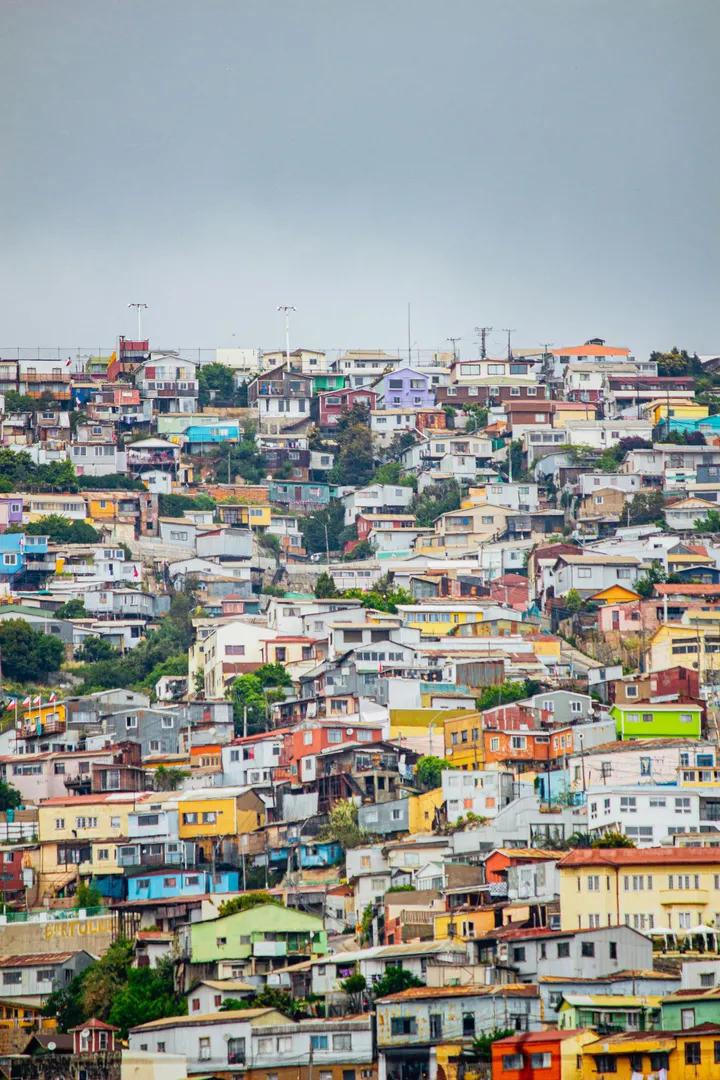
Valparaíso, which Chileans usually call Valpo, is the second largest urban area in Chile after Santiago. A city of 280,000 people built on 44 hills (the famous cerros) tumbling down to the Pacific, with a historic centre listed as a UNESCO World Heritage Site since 2003.
For an international student, Valparaíso has a very distinctive identity: a student city in the strong sense (close to one in six residents is a student), a dense cultural scene, street art on almost every wall, and several of the country's historic universities packed into a few square kilometres. Up to date for spring 2026.
Why study in Valparaíso in 2026
Valparaíso does not have Santiago's university density, but it offers something the capital cannot: the feel of a city-campus. Universities are woven into the urban fabric, most students live on the cerros overlooking the port, and the cultural life is largely carried by the student population.
Three reasons consistently come up among international students who choose Valparaíso, Chile:
- A human-scale city. You move around mostly on foot, by micro (local bus) or by funicular. Distances are short, you keep running into the same faces, and you end up with your own café, your own beach and your own staircase.
- Cultural immersion. Street art on nearly every wall, a documentary film festival (FIDOCS), poetry (Pablo Neruda kept one of his three houses here, La Sebastiana), and a dense independent music scene. By size, it is one of the culturally richest cities in Latin America.
- The Pacific and the region. Valparaíso is part of the Gran Valparaíso conurbation alongside Viña del Mar and Concón. A few minutes by bus or train and you swap the UNESCO port for open beaches, vineyards (Casablanca Valley) and seaside villages (Zapallar, Maitencillo).
The climate is oceanic: mild year-round, with morning mists (camanchaca) that usually lift by late morning, cool but rarely freezing winters (8-15 °C in June-August) and temperate summers (18-24 °C in December-February).
The universities of Valparaíso
Four universities make up most of Valparaíso's student life, and together they form the local Consejo de Rectores Valparaíso. All of them welcome international students and have exchange agreements with European and North American institutions. Below they are listed without ranking, each with its own identity.
Pontificia Universidad Católica de Valparaíso (PUCV)
Founded in 1928, PUCV is one of Chile's oldest private Catholic universities. Its campuses are spread across the city (Casa Central on Avenida Brasil, engineering at Curauma, sciences at Sausalito). It is highly regarded in law, architecture, economics, communications and engineering. PUCV is a long-standing partner of European business and policy schools, and welcomes 800+ international students every year through its dedicated Incoming programme, including Spanish-language preparation courses.
Universidad Técnica Federico Santa María (USM)
Founded in 1931, USM is one of Latin America's leading engineering schools. Its historic Casa Central campus sits on Cerro Los Placeres, with a direct view over the port. Flagship programmes: civil, computer, mechanical, electronic and industrial engineering. The training is highly technical, the pace intense, and the atmosphere openly international. USM also has campuses in Santiago and Viña del Mar.
Universidad de Valparaíso (UV)
A public university founded in 1981, originally a branch of Universidad de Chile. UV covers a wide range of disciplines: medicine, law, psychology, arts, humanities and political science. Courses are mostly taught in Spanish. Its main buildings sit in the Plan (the lower city centre) and on Cerro Barón.
Universidad de Playa Ancha (UPLA)
A public university specialised in education sciences, humanities, sociology and sport. Its campus sits on the cerro of the same name (Playa Ancha) at the western edge of the city, with classrooms looking out over the Pacific. It is active in exchanges in literature, history, education and physical activity.
Two more universities have their main campuses in neighbouring Viña del Mar (10-15 minutes away on the Merval metro) and also welcome international students: Universidad Adolfo Ibáñez (UAI) for management and business, and Universidad Andrés Bello (UNAB) with a much broader catalogue. Plenty of international students live in Valparaíso and study in Viña, and vice versa. The two cities operate as a single university hub.
Visa and entry to Chile
Visa rules in Chile apply uniformly across the country, whether you head to Santiago, Valparaíso or Viña del Mar. The good news: for the vast majority of exchange students, it is straightforward. (For the full national framework, see our complete guide to studying in Chile.)
The tourist permit (90 days)
Citizens of the European Union, the United Kingdom and many other countries automatically receive a tourist permit on arrival in Chile, valid for 90 days. No paperwork is required before departure. That covers a summer school or a short exchange.
The prórroga (90-day extension)
If your stay exceeds 90 days (the common case for a full 5-month exchange semester), you can extend your tourist permit once directly from inside Chile. The procedure is called the prórroga de turismo. It is filed online on the Servicio Nacional de Migraciones website before the first 90 days expire, for a cost of around USD 100. It grants 90 extra days, which covers the length of a standard Chilean academic semester.
The alternative: leave and come back
Another option for extending your stay without going through the prórroga: leave the country and come back. On re-entry, you get a fresh 90-day tourist permit. This is the perfect occasion to travel in the region (Mendoza in Argentina, Cusco in Peru, Salta or Uyuni in Bolivia) while resetting your stay, with no prórroga fee to pay.
The student visa
For longer programmes (full year, master's, PhD) that go beyond what a tourist permit plus prórroga can cover, a formal student visa is available. It must be applied for at the Chilean consulate in your home country before departure. This is the more formal route, required for students enrolled in full-degree programmes.
Good to know
Visa rules can change. Before you travel, confirm the current conditions on the official website of the Chilean consulate in your country of residence. Forum threads or third-party sites are often outdated.
Registration and exchange application
If you go on exchange via your home university, your international relations office handles most of the paperwork directly with PUCV, USM, UV or UPLA. The four universities of Valparaíso have well-oiled Incoming offices used to receiving students from Europe and North America.
Standard documents to prepare:
- An academic file (transcripts, CV, motivation letter)
- A Spanish proficiency test (DELE B1 or B2) or, for some programmes, an English level certificate (TOEFL or IELTS)
- A copy of a valid passport
- One reference letter from a professor
Application calendars follow the Chilean semesters:
- First semester. Classes from March to July. Applications to be submitted between September and November of the previous year.
- Second semester. Classes from August to December. Applications to be submitted between March and May of the same year.
If you apply as a free mover (outside an exchange agreement), allow at least 6 months before the start of the semester to launch the paperwork. Each university has its own criteria and registration fees (typically between USD 50 and 200).
Finding student housing in Valparaíso
From experience, this is the most stressful step for most international students heading to Valparaíso: the city has a more informal rental market than a capital, and a particular geography (cerros, staircases, ascensores). The options are:
- University residences. Very limited in Chile, almost non-existent in Valparaíso for exchange students.
- Facebook groups and classified ads. Lots of listings (Arriendos Valparaíso Estudiantes, Pieza Valpo), little verification. Photos are sometimes misleading, properties run-down behind heritage facades, contracts informal. Handle with care if you are searching from abroad.
- Homestay (host family). A useful option for the first month, often with meals included. Budget EUR 450 to 600 per month (£385-£515 / $495-$660).
- Specialised platforms such as Flatmaters: homes in Valparaíso carefully selected, trusted landlords, contracts drafted by us. You pay from your home bank account, no need to open a Chilean account.
See our trusted student housing in Valparaíso
Rooms in shared houses on the cerros, studios in the Plan, homestays: all visited on the ground by our team.
Find my housingBe cautious of listings with abnormally low rents on sought-after cerros: they often hide run-down or poorly maintained homes. Every academic year, a share of international students switch homes after a few weeks because the quality was not what was promised. Picking a trusted, decent home almost always beats a deal that looks too good to be true.
Your first days on the ground
Chile's main international airport is Arturo Merino Benítez (SCL) in Santiago. There is no commercial airport in Valparaíso: you land first in Santiago, then continue to Valparaíso by bus (around 1h45, with Turbus, Pullman Bus or Condor Bus, EUR 8 to 12 / £7-£10 / $9-$13 one way). The main bus terminal in Valparaíso is next to the Rodoviario station, in the city centre.
Checklist for the first 7 days:
- Day 1. Arrival at the home, walk-through, key handover.
- Days 2-3. Chilean SIM card (Entel, Claro or Movistar; budget EUR 5 to 10 / £4-£9 / $5.50-$11 per month with data).
- Days 3-7. Get to know the cerros around your home, scout the most useful ascensores, first cafés, first supermarkets.
- Week 2. Start of term, campus tour, first lectures, first encounters with other international students.
The first days in Valparaíso are disorientating. The city is discovered on foot and by funicular, addresses are rarely easy to find, and you have to get used to the topography. But within two weeks, everything clicks. Students we host in Valpo often develop a very strong attachment to the city and its unique atmosphere.
Matthieu, co-founder of FlatmatersFrequently asked questions
Why study in Valparaíso, Chile?
Valparaíso is a UNESCO World Heritage city on the Pacific coast of Chile, with four well-known universities (PUCV, USM, UV, UPLA) gathered within a few kilometres. PUCV alone welcomes more than 800 international students each year.
The city has a strong student identity, a dense cultural and street-art scene, and easy access to beaches, vineyards and the Andes through the wider Gran Valparaíso area.
Which universities accept exchange students in Valparaíso?
All four main universities accept exchange students: the Pontificia Universidad Católica de Valparaíso (PUCV), the Universidad Técnica Federico Santa María (USM), the Universidad de Valparaíso (UV, public) and the Universidad de Playa Ancha (UPLA). They are members of the Consejo de Rectores Valparaíso.
Neighbouring universities in Viña del Mar (UAI, UNAB) also welcome international students. The two cities operate as a single university hub.
Is Valparaíso safe for international students?
Valparaíso is a lively port city that calls for standard urban awareness. Some areas around the port and parts of the Plan after dark are best avoided alone.
The cerros Alegre, Concepción, Bellavista, Barón and Playa Ancha and the areas around the universities are very busy with students. With usual precautions (keep your phone discreet, avoid certain isolated routes at night), the vast majority of international students complete their stay without incident.
Do I need a student visa to study in Valparaíso?
Visa rules are the same as for the rest of Chile. EU, UK and many other passport holders receive a 90-day tourist permit on arrival, with no paperwork before departure. For a 5-month exchange semester, the prórroga extends the permit by 90 extra days for around USD 100.
For longer programmes (full year, master's, PhD), a formal student visa must be requested at the Chilean consulate in your home country before departure.
Can you study in Valparaíso without speaking Spanish?
Yes, it is possible. Some courses are taught in English in private universities. For Spanish-taught courses, many international students arrive at beginner level and progress quickly thanks to immersion in Valparaíso.
Universities also run dedicated Spanish-for-foreigners courses. Between shared housing and daily life on the cerros, Spanish is picked up naturally on the ground.
How much does student housing cost in Valparaíso?
Student rents in Valparaíso sit between EUR 380 and 650 per month (£325-£560 / $415-$715) for quality housing. A room in a shared house on a cerro is typically EUR 380-500. A furnished studio in the Plan area costs EUR 450-650.
Homestays with meals included are usually around EUR 450-600 per month.