

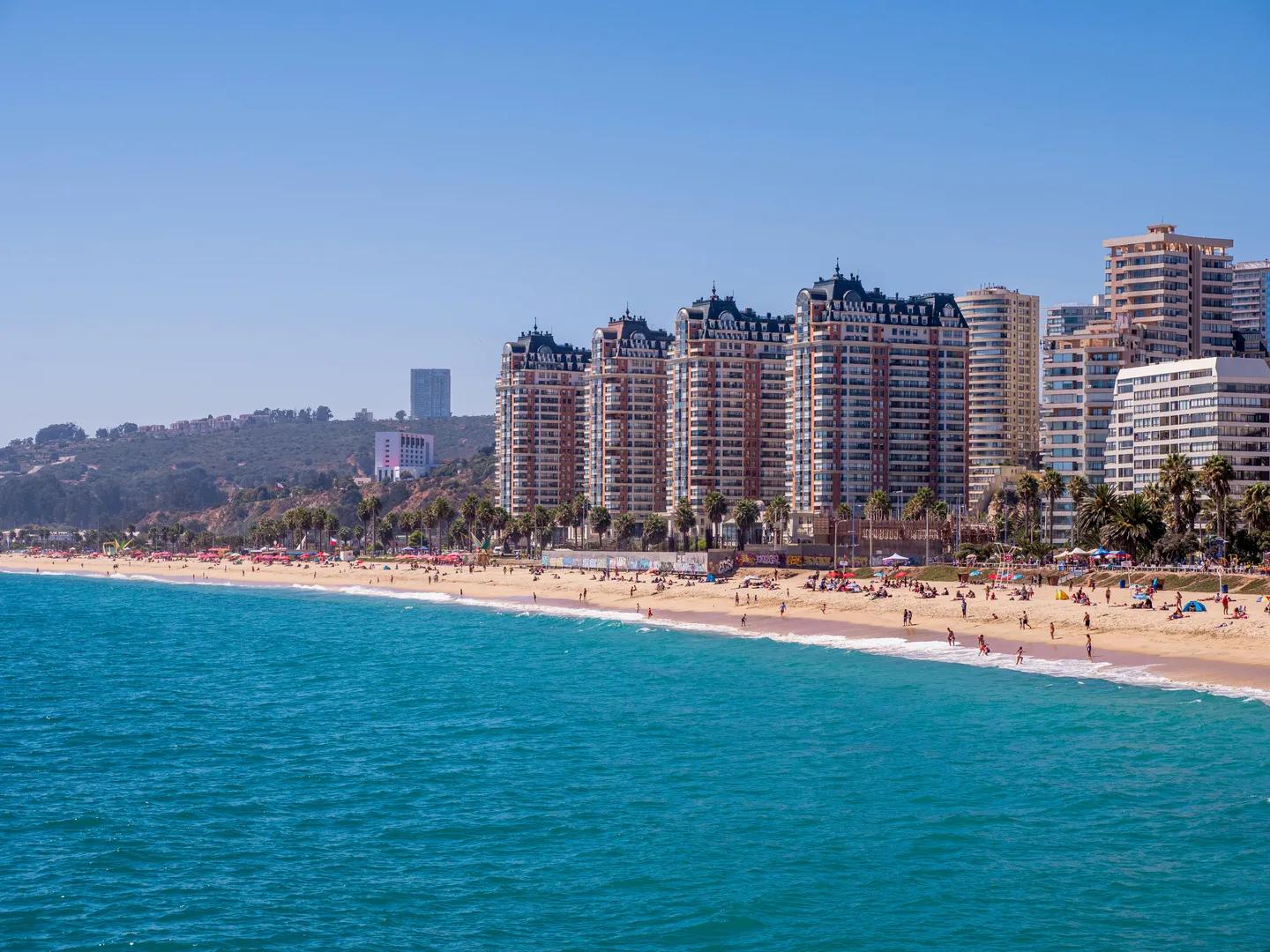
Viña del Mar is a city of 335,000 inhabitants on Chile's central coast, 120 km from Santiago and just north of Valparaíso (the two cities meet, with no visible border along the Avenida España). Nicknamed Ciudad Jardín, it has historically been Santiago's favourite seaside resort: wide avenues, public gardens, an architected seafront and urban beaches you can walk to.
What follows is everything we have observed on the ground hosting international students here: the layout, the sectors, the climate, the transport, the rhythm of student life, the beaches, the outdoor sports, where to eat, where to go out and the festivals that punctuate the year.
Viña del Mar, first impressions
The layout and the sectors
Viña is built around the Estero Marga Marga, a watercourse that crosses the city from east to west and meets the Pacific by the Casino. Calle Libertad and calle Valparaíso structure the centre. The city is split into sectors you quickly learn to navigate:
- Centro: the administrative and commercial heart, between the estero and Acapulco beach. Home to the Hotel O'Higgins, Plaza Vergara and calle Valparaíso with its shops and restaurants.
- Reñaca: the best-known beach in the area, 15 minutes by bus from the Centro. A seaside vibe, modern apartment blocks, beachfront bars.
- Miraflores: a residential sector on the heights, close to the UAI campus.
- Recreo and Caleta Abarca: between Viña and Valparaíso, quieter beaches and residential streets with bay views.
- Agua Santa, Achupallas, Forestal: residential sectors on the heights, with neighbourhood mercados and several student residences.
- Gómez Carreño and Reñaca Alto: to the north, more family-oriented, accessible by micros.
- Rodelillo: home to the UVM campus.
Climate and seasons
Mild oceanic climate, very stable year-round:
- Summer (December to March): 18 to 28 °C in the daytime. Packed beaches, festivals, life lived outdoors. This is also peak tourist season.
- Autumn (April-May): 14 to 22 °C, warm light, the city finds its student rhythm again after the summer.
- Winter (June to August): 10 to 18 °C, a few rainy spells, shorter days. Local insulation standards stay light: plan for an extra heater in seafront flats.
- Spring (September-November): 12 to 22 °C, often windy in the afternoon.
One local quirk: the wind. Afternoons can be very windy, particularly in spring. Mornings are often wrapped in sea mist (camanchaca) that lifts as the sun strengthens, usually around 11am-noon.
Getting around the city
Walking and cycling
Viña is flat, and that genuinely changes things. You can walk from the Centro to Caleta Abarca, from Acapulco beach to the Quinta Vergara, with no fatigue. Cycling works well along the Avenida Perú (the seafront cycle path) and on certain Centro routes. Many students invest in a second-hand bike in their first week.
Micros and colectivos
The micros (local buses) connect every sector for 500-700 CLP a ride. The colectivos (shared taxis on fixed routes, max 4 passengers) cover the same routes a little faster, for 800-1,500 CLP. Payment in cash or via TNE student card for those with a Chilean carnet de identidad.
The Metro Merval
The Metro Valparaíso (Merval) crosses Viña from west to east in 20 minutes, with 8 stations in the city. The line connects Valparaíso (Puerto) to Limache via Quilpué and Villa Alemana. Fare: 500-800 CLP depending on distance. Heavily used by students who live in Viña and study in Valparaíso (or the other way round).
Uber, DiDi and long-distance buses
Uber and DiDi work well across the entire Viña-Valparaíso area. Budget EUR 3-8 (£2.50-£7 / $3.30-$8.80) for an intra-Viña ride. For Santiago, buses leave every 15-20 minutes from the Rodoviario (Turbus, Pullman Bus, Condor Bus), EUR 8-12 (£7-£10 / $8.80-$13) one way, 1h45 depending on traffic on Route 68.
The student rhythm in Viña
Semesters are inverted compared with the northern hemisphere: first semester runs from March to July, second from August to December. University summer holidays: mid-December to early March. For an international student, that means the "studious" rhythm coincides with austral winter and spring, while the summer (January-February) is free, with the city switching into seaside mode.
Class days
Lectures at UAI, UVM, UNAB and the USM Viña campus run between 8.30am and 8pm, often with a long lunch break (1pm-3pm). Timetables are more spread out than in Europe, with 2 to 4 slots per day. Some courses (USM engineering, UNAB medicine) include evening labs.
Good news for international students: universities usually cluster their classes over 3 or 4 days a week to leave time for travel and exploration. Saturday morning classes, which exist for some Chilean tracks, never apply to international students.
Between classes
Student social life in Viña tends to revolve around the seafront: breaks on the Avenida Perú, cafés facing the Casino, lunches at the Mercado Achupallas or in the Centro's cocinerías. Universities regularly run welcome bienvenidas, inter-faculty sports cups and themed weeks.
The beaches in daily life
This is one of Viña's great assets. You live with the beaches a few steps away. Each sector has its beach, and students quickly develop their habits.
- Playa Acapulco: in the heart of the Centro, ideal for a break between classes, a picnic or a jog. Fine sand, busy all year.
- Playa El Sol: adjacent to Acapulco, family-friendly, very busy in summer.
- Caleta Abarca: between Viña and Valparaíso, with bay views and the start of the Avenida Perú. Quieter than the Centro.
- Playa de Reñaca: 15 minutes by micro or bus, 800 metres of sand, modern apartment blocks on the seafront. THE summer beach for Chilean students.
- Las Salinas: between Viña and Reñaca, more sheltered, calm, a favourite for swimming.
- Concón: the neighbouring city to the north, with dunes, seafood restaurants (Caleta de Higuerillas) and surf spots.
Useful tip
The ocean stays cool year-round (12-17 °C depending on the season) due to the Humboldt current. To surf or swim for any length of time, a wetsuit is almost mandatory, even in summer. That said, for sunbathing, reading or a seaside picnic, Viña offers daily beach access that is rare for an international student.
Outdoor sports and parks
Viña del Mar is a city that lives outdoors. Universities have their own sports facilities, but the city itself offers plenty.
Running and cycling
The Avenida Perú, which runs along the sea between Caleta Abarca and Acapulco beach, is the main running and cycling route. In the morning and at the end of the afternoon, you cross paths with runners, cyclists and surfers. The path continues north via Avenida San Martín up to Reñaca.
Surfing and water sports
Reñaca beach is a recognised surf spot, with several schools offering lessons and equipment hire (budget EUR 25-35 / £21-£30 / $27-$38 for a session including wetsuit). Nearby Concón has other well-known spots. Skimboarding, paddleboarding and kitesurfing are also practised.
Parks and nature
- Quinta Vergara: Viña's main urban park. Palacio Vergara, the Festival de la Canción amphitheatre, botanical gardens, footpaths.
- Parque Sausalito: an artificial lake, gardens, running and cycling paths. The Sunday family outing spot.
- Jardín Botánico Nacional: 400 hectares 10 km south-east of Viña, hiking trails and picnic areas.
- Concón dunes: a wild landscape between sea and forest, 15 minutes away.
Eating and drinking in Viña
Viña del Mar combines Chilean market cuisine, seafood restaurants and, increasingly, a brunch-and-café scene that draws on Santiago trends.
The markets
- Mercado Municipal de Viña: fruit, vegetables and fish in the heart of the Centro.
- Feria de Achupallas: a weekly market on the heights, very popular with students.
- Vega Central de Viña: fruit and vegetables at affordable prices.
- Caleta de Higuerillas in Concón: fresh fish straight from the fishermen.
Specialities and student-friendly addresses
- Completo (Chilean hot dog), empanada de pino (beef empanada), empanada de mariscos (seafood empanada): the classics for EUR 2-4 (£1.70-£3.40 / $2.20-$4.40).
- Ceviche and reineta a la plancha (grilled local fish) in seafront restaurants.
- Menú del día (set lunch) in the Centro's cocinerías: EUR 5-9 (£4.30-£7.70 / $5.50-$10).
- Chilean sandwiches (chacarero, barros luco) in fuentes de soda diners.
- Speciality cafés: Viña has a real café scene, around calle Valparaíso and calle Quillota.
Supermarkets
The main chains: Jumbo (flagship in the Centro, premium range), Líder and Santa Isabel (the two most affordable options for a student budget), Unimarc (mid-range). Small neighbourhood almacenes (corner shops) round out the network for daily shopping.
Going out and culture
Bars and nightlife
Calle Valparaíso, Plaza Sucre and the Reñaca seafront concentrate most of the nightlife. Cocktail bars, microbreweries, beachfront terraces, hotel rooftops. A drink costs EUR 4-7 (£3.40-£6 / $4.40-$7.70). Student parties start late (11pm-midnight) and run into the small hours.
Casino and cultural scene
The Casino Municipal de Viña del Mar, opened in 1930, is an iconic art deco building that also hosts shows and events. On the museum side: the Museo Fonck (archaeology, with an authentic Easter Island moai at the entrance), the Palacio Rioja and the Palacio Vergara in the heart of the Quinta Vergara.
Music and concerts
The Anfiteatro de la Quinta Vergara hosts the international Festival de la Canción every late February, along with many concerts throughout the year. Smaller venues (Casa de la Cultura, Teatro Municipal) programme shows year-round.
Find your student housing in Viña del Mar
Rooms in shared houses, studios near the campuses, homestays in the residential sectors: a vetted selection by our team.
Find my housingFestivals and traditions
Festival Internacional de la Canción (late February)
The Chilean cultural event par excellence. A week of concerts at the Anfiteatro de la Quinta Vergara, broadcast live on national TV. Latin American and international artists. The streets of Viña are packed, hotels are full, and the atmosphere is one of a kind.
Año Nuevo en el Mar (31 December)
The New Year's Eve fireworks show launched from the Valparaíso-Viña del Mar bay is one of the most famous in Latin America. Millions of spectators on the beaches, quays and balconies.
Fiestas Patrias (18-19 September)
Chilean national day. Asados everywhere, the cueca danced, fondas in the parks. In Viña, Parque Sausalito and the Quinta Vergara host the big public fondas.
Día del Patrimonio (last Sunday of May)
A day when many of the city's heritage buildings open for free: Palacio Rioja, Palacio Vergara, Palacio Carrasco, Casa Subercaseaux. An annual rendezvous to discover the architecture of the ciudad jardín.
Viña del Mar has this particular quality of being very accessible from day one: the city is quick to read, easy to find your way around, fast to settle into. The adjustment is mostly about adopting the seaside rhythm. Life is structured by the proximity of the ocean, the hours of sunlight, the wind. The students we host often develop sport routines here (running, surfing, cycling) they did not have back home.
Matthieu, co-founder of FlatmatersFrequently asked questions
Is Viña del Mar a good city for international students?
Yes. Viña del Mar combines a seafront location, a garden-city layout that is easy to read, five well-known universities within a small perimeter, an active cultural scene (the international Festival de la Canción) and quick connections to Valparaíso and Santiago.
The setting is ideal for students looking for a stable lifestyle, plenty of outdoor sport and daily access to the ocean.
What is the climate like in Viña del Mar?
Viña del Mar has a mild oceanic climate. Summers between 18 and 28 °C, winters between 10 and 18 °C. The wind picks up in the afternoons, especially in spring. Mornings can be wrapped in sea mist (camanchaca) that lifts in late morning.
Rainfall concentrates between June and August. The ocean stays cool all year (Humboldt current).
How do you get around in Viña del Mar?
The Centro is fully walkable. Micros (local buses) and colectivos (shared taxis on fixed routes) serve every district (Reñaca, Recreo, Miraflores, Achupallas). The Metro Merval connects Viña to Valparaíso, Quilpué, Villa Alemana and Limache. Uber and DiDi work well.
For Santiago, buses leave every 15-20 minutes from the Rodoviario terminal, with a 1h45 journey.
What is there to do in Viña del Mar as a student?
Enjoy the beaches (Acapulco, El Sol, Caleta Abarca, Reñaca), run or cycle along the Avenida Perú, visit the Quinta Vergara and the Reloj de Flores, attend concerts at the international Festival de la Canción (late February), surf at Reñaca, hike in Parque Sausalito and the Jardín Botánico Nacional, and head out to the bars on calle Valparaíso.
The Casino de Viña and the museums (Palacio Rioja, Museo Fonck, Palacio Vergara) round out the offer.
Is Viña del Mar safe?
Viña del Mar has a reputation as a relatively quiet residential city. The Centro, Reñaca, Recreo, Miraflores and Agua Santa areas are busy and students move around freely.
Standard urban awareness applies: keep your phone discreet, prefer Uber at night, avoid quiet streets after midnight. The vast majority of international students complete their stay without incident.
How long does it take to settle into life in Viña?
Viña del Mar is considered one of the easiest Chilean cities to get used to: the layout is readable, the distances are reasonable, the transport is simple. Day-to-day life usually settles in within two weeks. From the first month, students have their bearings, their café, their favourite beach.
The longest adjustment is often the Chilean accent and the local social rhythm.